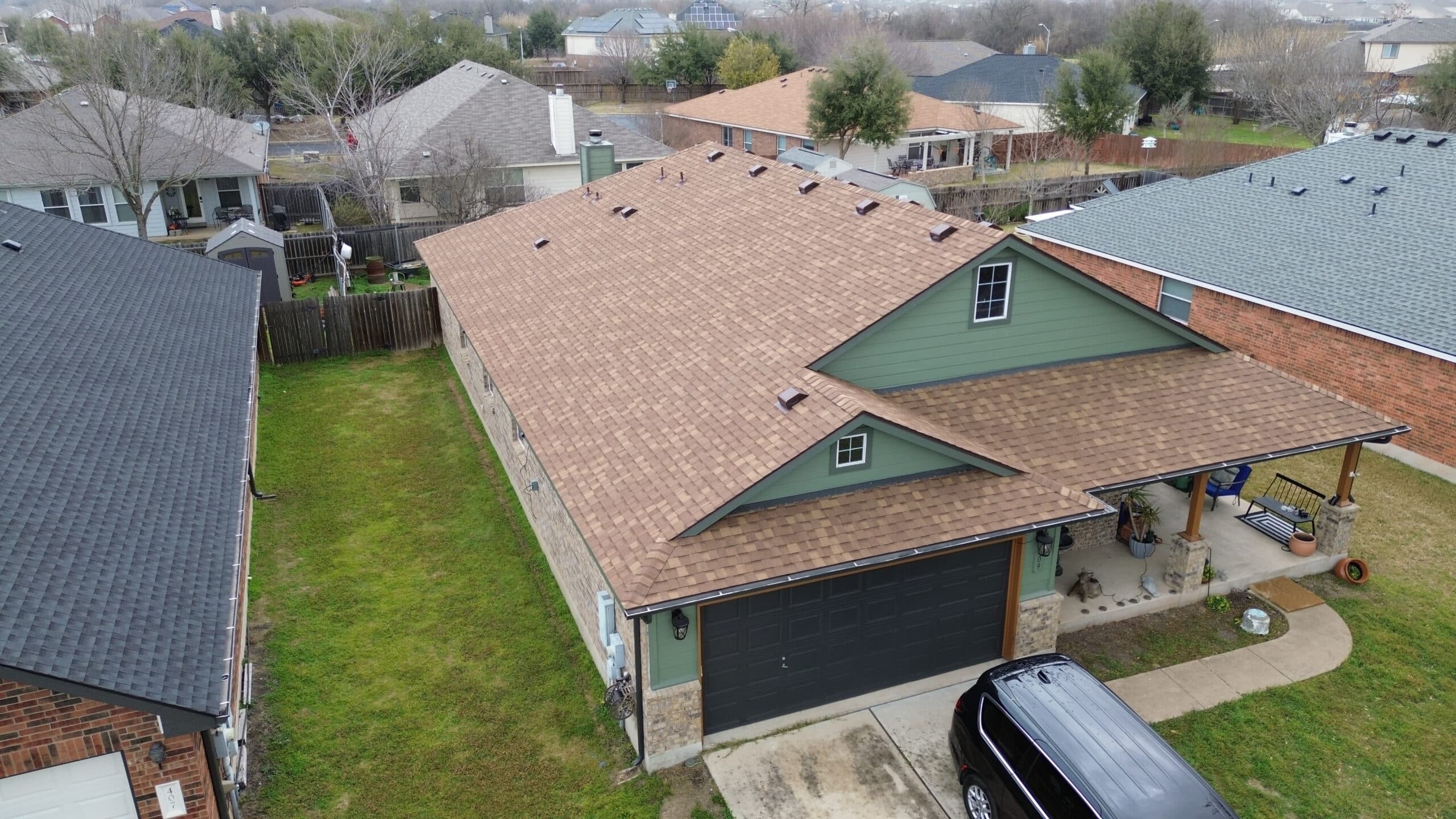
Lakeway Roofing Guide: What Lake Travis Does to a Roof
Quick answer: Lakeway's roofing challenges are driven by one factor most other Central Texas suburbs don't deal with — a large body of open water sitting next to nearly every neighborhood. That means higher ambient humidity, faster algae growth on north-facing shingle slopes, accelerated corrosion on unprotected metal fasteners, and — for waterfront lots — a second roofed structure to think about: the boat dock or boathouse. Add Lakeway's golf-course HOAs (The Hills of Lakeway, Rough Hollow, Flintrock Falls) with some of the strictest architectural review in the Austin area, and the roofing decision gets more complicated than "pick a shingle."
This guide focuses on what's actually specific to Lakeway: the lake's effect on materials, dock and boathouse roofing, and how each major community's architectural review committee (ARC) treats roof replacements. For general premium-material pricing shared across Hill Country upscale markets, see our Bee Cave guide — the two markets overlap on materials but differ in almost everything else.
Why Lake Travis Changes the Roofing Equation
Lakeway sits directly on the southern shore of Lake Travis, a Colorado River reservoir that runs for miles along the community's western and northern edges. Proximity to that much surface water affects roofs in three specific ways that inland Central Texas suburbs don't experience to the same degree:
1. Elevated ambient humidity. Water evaporating off the lake keeps humidity higher near the shoreline than a few miles inland, especially overnight and in early morning. Shingles stay damp longer after dew or light rain, which is exactly the condition blue-green algae (the black/green streaking you see on older roofs) needs to establish itself.
2. Faster algae and moss growth on shaded, north-facing slopes. Combine lake humidity with mature oak canopy — common throughout Lakeway — and north-facing roof planes that don't get direct afternoon sun can develop visible algae streaking years before the same shingle would on a dry, sun-exposed inland roof.
3. Accelerated corrosion on exposed metal. Standard steel fasteners, flashing, and hardware corrode faster in a humid lakeside microclimate than in drier parts of the Hill Country. This matters most on metal roofing and on any exposed hardware near the shoreline.
None of this means Lakeway roofs fail faster — it means material selection and detailing have to account for moisture in a way that a Round Rock or Pflugerville roof doesn't need to.
What to Specify Because of the Lake
- Algae-resistant shingles: Look for products with copper-infused or zinc-infused granules (most major manufacturers offer an algae-resistance line) — worth the modest upcharge on any north-facing or heavily shaded slope near the water.
- Stainless steel fasteners: Standard galvanized fasteners corrode faster in lakeside humidity; stainless is the right call for any home within roughly a half-mile of the shoreline, and non-negotiable for waterfront lots.
- Enhanced ridge and soffit ventilation: More airflow through the attic helps the deck itself dry out between humid stretches, which matters more here than in drier inland communities.
- Moisture-resistant synthetic underlayment: A better moisture barrier than felt, particularly valuable under valleys and around chimneys/skylights where trapped moisture does the most damage over time.
Boat Docks and Boathouses: The Roof Most Guides Forget
A meaningful share of Lakeway properties — especially in Rough Hollow and the waterfront sections of The Hills — include a private boat dock, and many of those docks have a boathouse or covered slip with its own roof. That structure faces a different set of conditions than the house roof:
- Direct water exposure: Spray, splash, and near-constant humidity at the waterline accelerate wear on any material that isn't corrosion-resistant.
- Fluctuating lake levels: Lake Travis is a flood-control reservoir, so water levels move up and down substantially over time (it's not unusual to see the shoreline several feet from where it sat a year earlier). Dock and boathouse structures are engineered to handle that, but it means the roofing hardware needs the same corrosion resistance as the dock hardware itself.
- Lighter structural loads: Dock and boathouse roof framing is typically lighter than house framing, which favors lightweight materials — standing seam aluminum or galvalume is the common choice over heavier tile or slate.
If you're re-roofing a boathouse or covered slip, treat it as a distinct scope from the house roof: different substrate, different fastener spec, and often a different permitting path through the Lower Colorado River Authority (LCRA) in addition to any HOA review, since LCRA manages the shoreline and dock permitting on Lake Travis. A contractor quoting "the roof" without asking whether you also have a dock structure hasn't fully scoped the job.
Lakeway's Communities and What Their Architectural Review Actually Looks Like
The Hills of Lakeway — Anchored by the private Jack Nicklaus Signature Golf Course, this is Lakeway's most tightly controlled community for exterior changes. Its ARC reviews roof color, material, and even sheen against a narrow, pre-approved palette, and multi-plane custom rooflines are common here, which adds both review complexity and installation labor. Homes range from the high six figures to well over $5M.
Rough Hollow — The lakefront and marina-access community, home to the Rough Hollow Yacht Club and the community most likely to include a private dock or boathouse in the property. Architectural review here is high-standard but generally faster-moving than The Hills, and reviewers are used to seeing corrosion-resistant material specs called out explicitly for waterfront lots.
Flintrock Falls — A gated golf community built around Hill Country terrain and a namesake waterfall feature. Rooflines here tend to be complex and custom, and the ARC expects earth-tone palettes that read naturally against the limestone and cedar landscape rather than lake views specifically.
Serene Hills — A newer, more traditionally suburban section of Lakeway with less architectural complexity than the golf communities and a more standard (if still active) HOA review process.
Lakeway Proper — The original sections of Lakeway, built mostly in the 1970s-1990s. HOA rules here are typically less restrictive than the newer golf communities, and a meaningful share of the roofing work is age-driven replacement on homes reaching the end of a 25-30 year shingle life rather than storm or renovation-driven work.
General Norms for Upscale HOA Roof Review (What to Expect Regardless of Community)
Architectural review committees across Lakeway's golf and lake communities share some common patterns worth knowing before you start:
- Pre-approved material and color lists: Most communities maintain a specific list of approved shingle products and a narrow earth-tone color range rather than leaving material choice fully open.
- Submission packages: Expect to submit product spec sheets, a color sample, and sometimes a site plan showing roof planes visible from the street or from neighboring lots.
- Review timelines run weeks, not days: Multi-week review is standard for architectural committees run by volunteer boards or a management company board that meets on a set schedule — plan your material selection and contractor choice early enough to absorb that timeline without holding up the rest of a renovation.
- Waterfront/view-corridor sensitivity: In lakefront communities, some ARCs also weigh how a roof reads from the water or from neighboring waterfront lots, not just from the street — worth asking about directly if you're on or near the shoreline.
A contractor who has actually submitted packages to a given community's ARC before can usually tell you realistic timelines and likely sticking points from experience — that's a fair, specific question to ask any contractor bidding lake-community work.
What Roofing Actually Costs in Lakeway
Pricing below reflects typical ranges for Lakeway home sizes and the material tiers common in the community. Actual cost depends on roof complexity, pitch, material choice, and site access.
By Home Size and Material Tier
Larger homes (2,500-4,000 sq ft):
- Premium architectural shingles: $28,000-$48,000
- Designer shingles: $38,000-$65,000
- Standing seam metal: $65,000-$130,000
- Clay or concrete tile: $75,000-$150,000+
Estate homes (4,000-6,000 sq ft):
- Premium architectural shingles: $45,000-$75,000
- Designer shingles: $60,000-$100,000
- Standing seam metal: $100,000-$180,000
- Clay or concrete tile: $120,000-$220,000+
Ultra-luxury estates (6,000-10,000+ sq ft):
- Premium architectural shingles: $70,000-$125,000+
- Designer shingles: $95,000-$165,000+
- Standing seam metal: $180,000-$350,000+
- Clay or concrete tile: $220,000-$450,000+
What Moves the Price in Lakeway Specifically
- Waterfront corrosion-resistant specs: Stainless fasteners and enhanced flashing add cost over a standard inland install but are the right spec for shoreline properties.
- Algae-resistant material upgrade: A modest per-square premium over standard shingles, generally worthwhile on shaded, north-facing slopes near the water.
- Multi-plane custom rooflines: Common in The Hills and Flintrock Falls — adds 20-40% versus a simple roof geometry due to additional flashing, valleys, and labor.
- Steep pitches: Common on Hill Country custom homes — adds 15-35% for safety equipment and slower installation pace.
- Dock/boathouse structures: Typically quoted as a separate line item from the house roof, often in the low thousands for a standard covered-slip roof depending on size and material.
- Oak canopy management: Mature live oaks are common throughout Lakeway; a professional arborist assessment or trim before a re-roof runs roughly $500-$3,000, and a crane lift over trees for equipment access can add $2,000-$8,000 when tree cover blocks a standard staging area.
Materials Worth Considering for a Lakeside Property
Standing seam metal (aluminum or zinc) is the material most often recommended for waterfront and near-shore Lakeway homes specifically because it resists the corrosion and moisture issues the lake creates better than shingle products do, while also matching the contemporary aesthetic common in Rough Hollow. Zinc develops a matte gray patina over decades and carries an 80-100+ year lifespan; aluminum runs $700-$1,200 installed per square with a 50-70 year lifespan and a wider color range.
Copper is the premium choice for statement homes and iconic Hill Country architecture — it develops a natural patina over time and is essentially immune to the corrosion concerns that make lakeside humidity a factor for lesser metals, at $1,200-$1,800 installed per square with a 70-100+ year lifespan.
Algae-resistant designer shingles (GAF Grand Sequoia, CertainTeed Belmont, Owens Corning Berkshire, all $250-$370 per square in materials) remain the right call for traditional Hill Country architecture and for ARCs that specify shingle-only palettes, provided you confirm the algae-resistant granule option is included.
Clay or concrete tile ($800-$2,200 installed per square, 50-100+ year lifespan) suits Mediterranean and Spanish Hill Country designs but requires a structural load check before specifying — tile is significantly heavier than shingle or metal, and older Lakeway Proper homes in particular may need a framing assessment first.
Vetting a Contractor for Lakeside and Golf-Community Work
The baseline expectations for any Lakeway roofing contractor are straightforward, and the honest way to verify them is different than what a lot of marketing copy implies. Texas does not issue a state roofing contractor license — there is no state licensing board to check a contractor against, so "are you licensed" is the wrong question. The questions that actually protect you:
- "Can I see your Certificate of Insurance, and can I confirm it directly with your carrier?" — a reputable contractor provides this without hesitation; $1M+ general liability plus workers' compensation is the standard to look for.
- "What manufacturer certifications do you hold, and can you show me the certificate?" — CertainTeed ShingleMaster Premier, for example, is a real, verifiable credential (CertainTeed places it in the top 1% of contractors nationally) that means something specific about training and installation standards — unlike a license, which doesn't exist to check.
- "Which Lakeway HOAs have you actually submitted ARC packages to, and what happened?" — a contractor with real experience here can describe specific review quirks (The Hills' narrow color palette, Rough Hollow's waterfront hardware questions) rather than a generic answer.
- "How do you protect a boat dock, retaining wall, or waterfront landscaping during installation?" — waterfront lots have site-access and protection considerations a standard suburban install doesn't.
- "What's your corrosion-resistant fastener spec for waterfront work?" — a contractor who doesn't have a ready answer probably hasn't done much lakeside work.
Red flags stay the same as anywhere: pressure to sign same-day, no verifiable local references, a bid dramatically below every other bid, or no manufacturer certification to show you.
Common Lakeway Roof Problems, Ranked by How Often We See Them
1. Algae staining on shaded north slopes — the single most common lake-driven issue, and the most preventable with an algae-resistant product at install time.
2. Corrosion on unprotected fasteners near the shoreline — shows up as rust streaking around flashing and exposed hardware; largely a spec problem (wrong fastener grade) rather than a material-quality problem.
3. Oak limb and storm damage on exposed hilltop lots — Lakeway's elevated terrain means more direct wind exposure than lower-lying inland neighborhoods; Class 4 impact-resistant materials and a 130 mph+ wind rating are the standard recommendation for exposed sites.
4. Valley and flashing leaks on complex custom rooflines — more roof planes means more valleys, and valleys are where the majority of leaks in custom Hill Country homes originate; this is a detailing and workmanship issue more than a material one.
5. UV degradation on south/west-facing slopes — standard Central Texas sun exposure, addressed the same way anywhere: reflective granules, proper attic ventilation, and realistic replacement timing rather than waiting for visible failure.
Why Ripple for a Lakeway Roof
We're a CertainTeed ShingleMaster Premier certified contractor — a credential CertainTeed places in the top 1% of contractors nationally — and we're also SBA Veteran-Owned Certified, a federal Veteran-Owned Small Business certification through the U.S. Small Business Administration. We carry $1M general liability insurance and workers' compensation, both of which we'll put you in touch with our carrier to verify directly rather than just asserting.
What that means for Lakeway specifically: we spec corrosion-resistant fasteners and algae-resistant materials as a default on shoreline and heavily-shaded jobs, we handle ARC submission paperwork for you, and we treat a boat dock or boathouse roof as its own scope rather than an afterthought.
Our Process
Phase 1 — Consultation (Week 1): In-home assessment, material selection with samples, written proposal, financing options if needed.
Phase 2 — ARC/HOA and permitting (Weeks 2-6): We submit your community's architectural review package and pull Travis County permits. This is the phase most likely to set your overall timeline — plan for it.
Phase 3 — Installation (1-5 days depending on size): Site and dock protection setup, daily photo updates, project manager on-site, daily cleanup.
Phase 4 — Completion: Final inspection, walkthrough, magnetic sweep of the property, warranty documentation.
Get in Touch
Call: (512) 763-5277 Email: tx@rippleroofs.com Online: RippleRoofs.com/lakeway
Frequently Asked Questions — Lakeway Roofing
Q: Does living near Lake Travis actually affect what roofing material I should choose? A: Yes. Higher ambient humidity near the shoreline accelerates algae growth on shaded slopes and corrosion on unprotected metal hardware. The practical fixes are algae-resistant shingle granules, stainless steel fasteners, and — for waterfront lots — corrosion-resistant standing seam metal (aluminum or zinc) rather than standard galvanized components.
Q: Do boat docks and boathouses need a different roofing approach than the house? A: Yes. Dock and boathouse roofs face direct water exposure and fluctuating lake levels, and typically use lighter-weight standing seam aluminum or galvalume with corrosion-resistant hardware. They're usually quoted and permitted separately from the house roof, and LCRA (Lower Colorado River Authority) may be involved in permitting in addition to your HOA.
Q: How much does a roof replacement cost for a Lakeway home? A: Typical ranges run $35,000-$150,000+ depending on size and material: roughly $35,000-$75,000 for 2,500-4,000 sq ft homes with premium materials, up to $95,000-$250,000+ for ultra-luxury estates over 6,000 sq ft. Waterfront corrosion-resistant specs and multi-plane custom rooflines push costs toward the higher end of each range.
Q: How long does HOA or ARC approval take in Lakeway communities like The Hills or Rough Hollow? A: Plan for several weeks, not days — architectural review committees typically meet on a set schedule and require a full submission package (material spec, color sample, sometimes a site plan) before they'll review. The Hills of Lakeway has the most detailed review process in the community; Rough Hollow and Flintrock Falls are generally faster but still multi-week.
Q: Is a Texas roofing contractor license required? A: No — Texas does not issue a state roofing contractor license, so there's no license number to verify. The two things worth verifying instead are general liability insurance (confirm the Certificate of Insurance directly with the carrier) and manufacturer certification (such as CertainTeed ShingleMaster Premier), both of which are checkable.
Q: What's the best roof material for a home directly on Lake Travis? A: For waterfront lots specifically, standing seam aluminum or zinc is generally the strongest choice — it resists the corrosion that lake humidity accelerates in standard materials and holds up well against direct water exposure near the shoreline. Copper is the premium option for statement architecture. If your HOA requires shingles, choose an algae-resistant product and specify stainless steel fasteners.
Q: Will a new roof increase resale value in Lakeway's luxury market? A: A well-maintained, correctly-specified roof removes a common objection for buyers evaluating high-end waterfront and golf-course properties, and avoids inspection-driven price negotiations at resale. Buyers in this price range tend to expect move-in-ready condition rather than deferred maintenance.
Protecting a Lakeway Property Long-Term
The lake is what makes Lakeway distinct, and it's also the specific variable that should drive your roofing decisions here — not a generic "luxury home" checklist. Algae-resistant materials, corrosion-resistant hardware, a dock/boathouse scope handled correctly, and a contractor who has actually worked through your community's ARC process are the things that matter most.
Call: (512) 763-5277 Email: tx@rippleroofs.com Online: RippleRoofs.com/lakeway
About Ripple Roofing & Construction
Ripple Roofing & Construction is a Round Rock, TX-based, owner-operated roofing contractor serving Lakeway and the greater Austin area. We're CertainTeed ShingleMaster Premier certified (top 1% of contractors nationally) and SBA Veteran-Owned Certified.
Services: Roof Replacement, Standing Seam Metal & Tile Installation, Storm Damage Restoration, HOA/ARC Submission Support
Serving Lakeway: The Hills of Lakeway, Rough Hollow, Flintrock Falls, Serene Hills, and Lakeway Proper
Contact: (512) 763-5277 | tx@rippleroofs.com | RippleRoofs.com
CertainTeed ShingleMaster Premier Certified | SBA Veteran-Owned Certified | $1M General Liability Insurance | 5.0/5 Stars on Google