Roof Repair in Taylor TX: Costs, Common Issues & When to Call a Contractor
Here's a number worth sitting with: the average roof replacement in Taylor, Texas runs between $12,000 and $22,000. The average targeted roof repair runs between $300 and $1,500. For homeowners who have a specific problem — a leaking pipe boot, a section of blown-off ridge cap, a valley that's started to seep — the difference between repair and replacement can be the difference between a manageable maintenance expense and a five-figure project.
The challenge is knowing which one you're actually dealing with.
Taylor's housing stock makes that assessment more complicated than it is in most Central Texas cities. A new-construction home in Taylor Ranch has a completely different roofing profile than a 1950s craftsman bungalow near the historic downtown square. An older home may need a repair that's straightforward in one sense but structurally nuanced in another — board sheathing, aging valleys, original-era flashings. A Samsung-era new build in one of Taylor's expanding subdivisions may only need a single pipe boot replacement, but that same home may also have builder-grade components that are quietly failing across multiple points.
This guide walks through the most common roof repairs we perform for Taylor, Texas homeowners — with real cost ranges, red flags, a clear repair-vs-replace framework, and everything you need to know to make a smart decision without getting oversold on a full replacement you don't need.
Taylor's Roofing Repair Landscape: Why It's Different
Before diving into specific repair types, it's worth understanding what makes Taylor's repair environment distinct from nearby cities like Round Rock or Pflugerville.
A Century of Construction Under One Zip Code
Taylor's housing stock genuinely spans the full arc of Texas residential construction:
Pre-1950 homes near the historic downtown are often on their second or third roof system. Many have 1×6 or 1×8 tongue-and-groove board sheathing instead of modern OSB or plywood panels. Repairs on these homes require installers who understand how to properly flash, nail, and seal against board surfaces, how to identify rot in individual boards, and when board repair or overlay is the right call versus full sheathing replacement.
1950s–1980s ranch-style homes represent a large portion of Taylor's established neighborhoods. These homes often have original pipe boots that have long exceeded their service life, aging lead flashings that may have cracked or pulled away from penetrations, and ventilation systems that were installed to the lower standards of their era.
1990s–2010s tract homes are the generation that saw Taylor's first major growth period. These roofs are now 15–30 years old — old enough to have significant wear but not automatically in replacement territory. This is the most common age range for productive targeted repairs.
2010s–present new construction in neighborhoods like Taylor Ranch and areas adjacent to the Samsung semiconductor campus are often still under builder warranty or barely past it. Repairs here are usually isolated — a single pipe boot, a small flashing gap, a gutter that's come loose — but these homes need inspection to catch builder-grade component failures before they cascade.
Eastern Williamson County Weather Exposure
Taylor sits on the eastern edge of Williamson County, where open terrain amplifies storm exposure compared to the more urbanized western suburbs. The two most important weather factors for Taylor roof repairs:
Hail accumulation: Taylor is regularly in the path of hail events that track northeast from the Hill Country. Unlike visible wind damage or a dramatic active leak, hail damage is cumulative and often invisible from the ground. Granule loss at impact sites accelerates shingle aging by years. A roof that looks serviceable from the street may have documented hail damage that qualifies for an insurance-funded repair or replacement.
Wind and edge damage: High-wind events — common in Central Texas severe weather — preferentially damage roof edges: ridge caps, starter courses, and drip edges. These are repairable areas where catching damage early prevents water infiltration that turns a $500 repair into a $3,000 decking and shingle repair.
The 8 Most Common Roof Repairs in Taylor TX
1. Pipe Boot Replacement
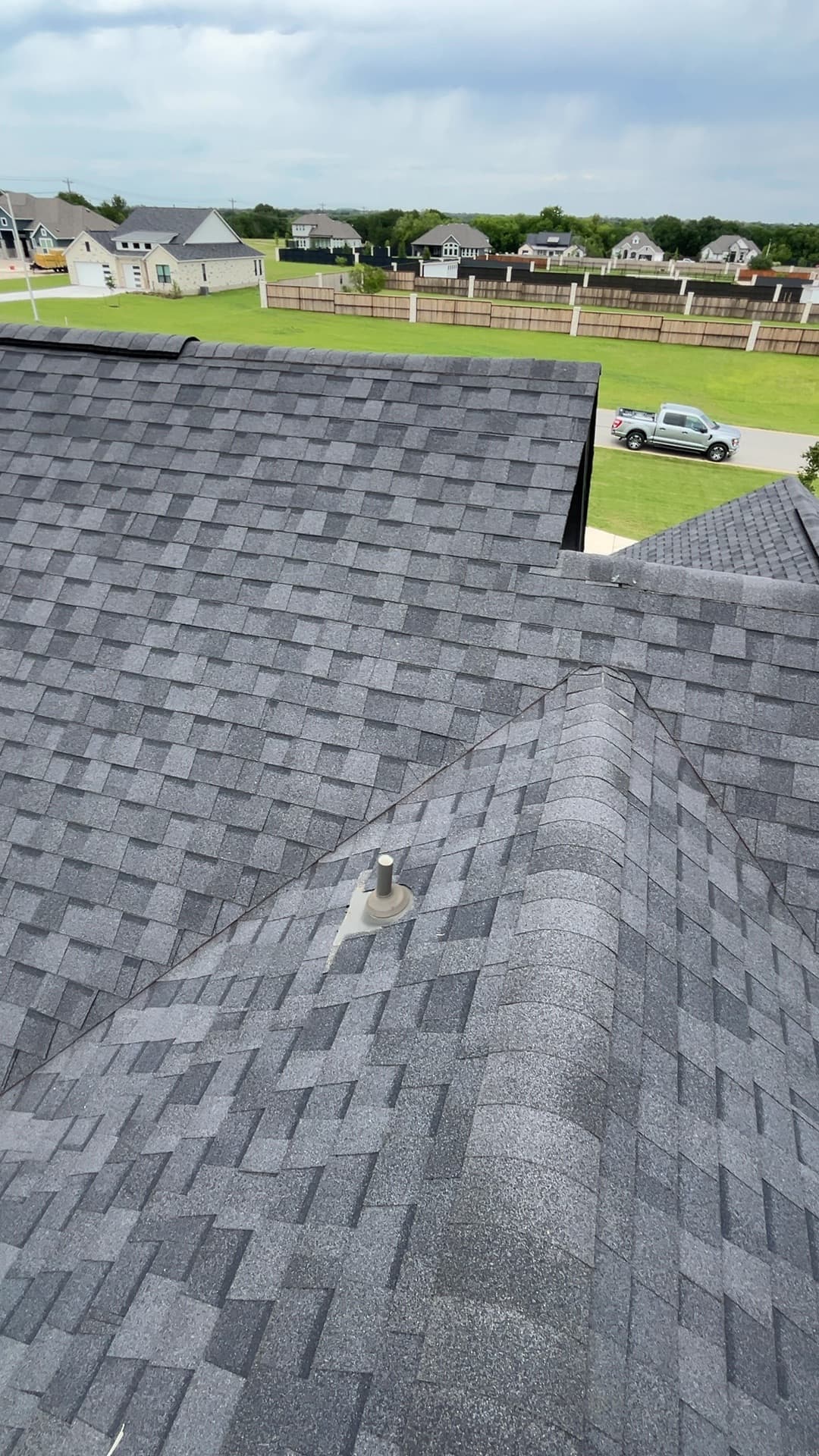
What it is: Every plumbing vent pipe that penetrates your roof is sealed with a "pipe boot" — a rubber or lead collar that fits around the pipe and seals against the shingles. The rubber formulation used in most builder-grade boots has a service life of 10–15 years in Texas heat before it begins cracking and pulling away from the pipe.
Why it's the #1 repair call in Taylor: Taylor has a substantial stock of homes built between 1995 and 2015, which means a huge share of the city's housing is right at or past the pipe boot replacement window. We replace more pipe boots than any other single component.
What failure looks like: Active drips inside the home — often in bathrooms, laundry rooms, or directly below a plumbing vent location. Sometimes the failure is slow enough that the first sign is a water stain on a ceiling rather than an active drip. The water stain may appear feet away from the actual leak source due to how water travels along structural members before dropping.
What the repair involves: A qualified Taylor TX roofing contractor removes the shingles immediately surrounding the boot, removes the old boot, installs a new neo-prene or silicone boot (both outlast rubber significantly in Texas heat), and relays the shingles properly with fresh sealant. In most cases, the surrounding shingles are not damaged and can be reused.
Cost in Taylor TX: $175–$375 per boot, depending on pipe diameter and roof pitch. Most homes have 2–5 plumbing vents. Proactive replacement of all boots at once is significantly cheaper per unit than separate service calls.
Insurance note: Pipe boot failure from normal aging is typically not covered. Pipe boot damage from a qualifying hail or wind event may be covered — a contractor inspection documents the distinction.
2. Step Flashing and Counter Flashing Repair
What it is: Anywhere your roof meets a vertical surface — a chimney, a dormer wall, a second-story exterior wall — there's a flashing system that seals the transition. Step flashing is the L-shaped metal pieces that interleave between each course of shingles and the vertical surface. Counter flashing (on masonry structures like chimneys) is embedded into the mortar joints and folds down over the step flashing to create a watertight double seal.
Why it fails: Sealant deteriorates (especially in Taylor's heat extremes), the underlying mortar on older chimneys cracks and allows counter flashing to pull free, and house settling can shift the step flashing out of plane over time. Older lead flashing on pre-1980 homes is prone to cracking and fatigue.
What failure looks like: Water intrusion specifically at a wall-to-roof transition point. Staining on interior walls below a chimney or dormer. Water appearing inside the home during rain, with the entry point at the wall rather than the field of the roof.
What the repair involves: On a chimney, re-bedding the counter flashing into repointed mortar joints and resealing the step flashing below. On wall transitions, removing the siding and counterflashing, inspecting and repositioning the step flashing, and resealing. On older Taylor homes with lead flashing, the flashing itself often needs replacement rather than just resealing.
Cost in Taylor TX: $350–$1,200 depending on the length of the flashing run and whether repointing or siding removal is required. A chimney with deteriorated counter flashing on all four sides runs toward the higher end.
3. Valley Flashing Repair and Replacement
What it is: A valley is where two roof planes meet in a "V" shape. Valleys are high-water-flow zones — every drop of rain that lands on the two adjoining planes drains through the valley. Valley flashing (either metal valley flashing or woven shingle valleys) must remain intact to handle that concentrated water volume.
Why it fails: In Taylor's older homes, open metal valleys (W-metal or V-metal) are common. The sealant at valley edges degrades, the metal itself can corrode on very old installations, and ice dams (rare in Taylor but not impossible) can pull metal valley flashing loose. On woven or closed-cut shingle valleys, shingle wear at the high-traffic center line can open small gaps where water infiltrates the underlayment.
What failure looks like: Interior water intrusion at a location that corresponds to a valley on the exterior. The leak often appears at the bottom of the valley — because that's where water volume is highest and where most metal valley flashing terminates near the eaves.
What the repair involves: Replacement of the valley flashing (metal valleys) or a targeted shingle weave repair (woven valleys). Metal valley replacement requires removing shingles along both flanks of the valley, pulling the old flashing, and installing new metal with proper overlaps and edge sealant.
Cost in Taylor TX: $450–$1,400 per valley, depending on valley length and whether it's a simple metal replacement or a more complex woven repair. On older Taylor homes with multiple valleys and board sheathing, the repair is at the higher end.
4. Ridge Cap Replacement
What it is: Ridge caps are the specialized shingles (or metal cap pieces) that cover the peak of your roof where two planes meet. They're exposed to the highest wind pressure on the entire roof surface and take significant UV punishment since they sit horizontally at the apex.
Why it fails: Wind events are the primary culprit — a 60 mph gust during a Taylor thunderstorm can lift individual ridge cap shingles or entire ridge cap sections. UV degradation over time makes the adhesive strips less effective, and older 3-tab ridge caps simply don't hold as well as modern laminated ridge cap products.
What failure looks like: Missing or displaced ridge cap shingles are usually visible from the street — they create obvious dark gaps at the roof peak. Wind-lifted ridge caps sometimes stay in place but are no longer sealed, which may not be visible until it rains.
What the repair involves: Removing any remaining damaged ridge cap, inspecting the underlying ridge board or OSB for moisture damage (a common finding when ridge caps have been absent for an extended period), and installing new laminated ridge cap shingles with proper fastening patterns.
Cost in Taylor TX: $350–$900 for a standard ridge replacement, depending on ridge length. Hip roofs with multiple ridge and hip cap runs cost more. If the underlying ridge board has moisture damage, add $100–$400 for board repair or replacement.
5. Roof Decking Repair (Rot or Impact Damage)
What it is: Roof decking — the OSB or plywood (or board sheathing on older Taylor homes) that the shingles are nailed to — can develop rot from prolonged moisture infiltration through failed boots, flashings, or valleys. In rare cases of large hail impact, the decking itself can be cracked or compressed.
Why it matters: Decking rot is a slow-moving structural problem. A small area of rot at a failed pipe boot location can spread outward to adjacent sheets if not addressed. Structurally compromised decking doesn't hold fasteners properly, which reduces shingle adhesion and eventually creates "soft spots" that can be felt underfoot.
What it looks like: Soft or spongy areas when walking on the roof. Visible discoloration (darkening) of OSB from above during a repair. In severe cases, visible sag at the affected area from below (attic or interior ceiling).
What the repair involves: Removing shingles and underlayment in the affected area, cutting out the damaged decking sheet(s), and installing new OSB or plywood. On board-sheathed homes, individual boards that are rotted are removed and replaced. The new decking is then re-shingled with matching materials.
Cost in Taylor TX: $80–$120 per sheet of OSB installed (plus labor), on top of the overlying repair cost. A typical small rot patch is 1–3 sheets. Extensive rot from a long-running undiscovered leak can be much more.
6. Fascia and Soffit Repair
What it is: The fascia is the flat board that runs horizontally at the roof edge, to which gutters are attached. The soffit is the underside of the roof overhang. Both are vulnerable to moisture damage from overflowing gutters, failed drip edges, and inadequate ventilation.
Why it fails: Taylor's heavy spring rain events regularly overload gutters that are undersized or clogged, causing water to back up against the fascia. Over seasons, this produces rot in wood fascia boards. Damaged or missing soffit allows pests (birds, squirrels, wasps) to access the attic space.
What it looks like: Visibly rotted, soft, or peeling fascia boards — often spotted when gutters are being inspected. Holes or gaps in soffit panels. Evidence of pest activity at soffit vents.
What the repair involves: Removing damaged fascia or soffit sections, treating adjacent areas for moisture, and installing new material (wood, aluminum-wrapped, or vinyl). Addressing the root cause (undersized gutters, missing drip edge) is critical to prevent recurrence.
Cost in Taylor TX: $400–$1,500 depending on linear footage and material. Aluminum-wrapped fascia is more expensive upfront but resists moisture significantly better than painted wood.
7. Spot Shingle Replacement
What it is: Individual shingles or small sections that have been physically damaged — by hail impact (cracked through the mat), by wind (torn away from the roof), or by falling debris — can often be replaced without a full roof intervention.
When it works: Spot repair is appropriate when the surrounding shingles are in good condition (adequate granule coverage, no widespread granule loss pattern, no cracking). It's a targeted fix for an isolated problem.
When it doesn't: If the surrounding shingles are clearly aged, have widespread granule loss, or the roof has sustained hail damage across its entire field, spot replacement creates a patchwork that delays the inevitable rather than solving the problem.
What the repair involves: Carefully removing the damaged shingles (and the nails holding adjacent shingles that overlap the damaged area), installing new matching shingles, and hand-sealing the joints. On older roofs, an exact color match may be difficult — newer shingles often look different from weathered ones.
Cost in Taylor TX: $250–$800 for a small spot repair. If shingles are custom-ordered or a color match requires sourcing, add lead time and potentially higher material costs.
8. Gutter Repair and Reattachment
What it is: Gutters are technically separate from roofing but are structurally dependent on the roof's fascia and drainage system. Failed gutters that allow water to pool against the fascia or foundation are one of the most common causes of the fascia rot and foundation issues we see in Taylor.
Common gutter repair types: Reattaching gutters that have pulled away from the fascia (spike-and-ferrule systems are notorious for this), resealing gutter seams that have opened, replacing downspouts that have been damaged or disconnected, and adding downspout extensions to direct water away from the foundation.
Why it matters in Taylor: Taylor Creek and its tributaries mean significant local drainage considerations. Directing roof runoff appropriately — away from the foundation, toward the street or a rain garden — matters here more than in most Williamson County locations.
Cost in Taylor TX: $200–$800 for standard gutter reattachment and seam repair. Full gutter replacement ($1,200–$3,500 for a typical Taylor home) is a separate project, but one worth considering if gutters are consistently failing or were undersized originally.
Roof Repair Cost Summary: Taylor TX (2026)
| Repair Type | Typical Cost Range |
|---|---|
| Pipe boot replacement (per boot) | $175–$375 |
| Step/counter flashing repair | $350–$1,200 |
| Valley flashing replacement | $450–$1,400 |
| Ridge cap replacement | $350–$900 |
| Roof decking repair (per sheet + labor) | $200–$400 |
| Fascia and soffit repair | $400–$1,500 |
| Spot shingle replacement | $250–$800 |
| Gutter repair and reattachment | $200–$800 |
Service call / inspection: Reputable Taylor TX roofing contractors typically offer free inspections for repair quotes. Be cautious of contractors who charge a fee to diagnose a leak — that's unusual and not standard practice in this market.
Taylor-Specific Repair Scenarios by Home Age
The age of your Taylor home significantly shapes what repairs you're likely to need — and how they should be approached.
Pre-1970 Homes: Historic Downtown and Established Neighborhoods
If your home was built before 1970, your roof has been replaced at least once and possibly twice. The critical differences on these homes:
Board sheathing: Virtually all homes built before the mid-1970s in Taylor have 1×6 or 1×8 tongue-and-groove board sheathing. This isn't a liability — board sheathing can be excellent — but repairs must be done by crews who know how to nail into boards properly, how to identify which boards are compromised, and when a board needs replacement versus treatment. A crew experienced exclusively with OSB decking may not have this knowledge.
Original-era ventilation: Pre-1970 homes often have ridge vents, gable vents, or static vents from an era when attic ventilation standards were lower. If your repair includes any decking work, it's worth having a contractor assess whether your ventilation is adequate. Insufficient attic ventilation in Taylor's summer heat accelerates shingle aging from below.
Lead flashing on chimneys: Older Taylor homes with chimneys often have lead flashing that has far exceeded its service life. Lead does last a long time, but decades of thermal expansion and contraction eventually creates fatigue cracking. If your chimney flashing is original to the home, it may be approaching or past replacement territory regardless of whether you're seeing an active leak.
What to prioritize: On a pre-1970 Taylor home, a comprehensive inspection that inventories flashing condition, pipe boot status, ventilation adequacy, and decking condition at all penetrations is more valuable than addressing one problem at a time. Multiple small issues in this age range often indicate a pattern.
1970–2000 Homes: Taylor's Mid-Century Stock
Homes from this era are the most likely candidates for targeted repair rather than full replacement — but also the most likely to have multiple simultaneous issues.
First-generation synthetic materials: Many 1970s–1990s homes were reroofed in the 1990s or 2000s with the first generation of builder-grade architectural shingles. These products are now 20–30 years old — at the outer edge of their rated lifespan in Texas conditions.
Rubber pipe boots: The rubber compound used in pipe boots from the 1990s and 2000s is definitively past its service life. If you haven't had a pipe boot inspection on a home in this age range, schedule one. A failed boot rarely announces itself dramatically — it drips slowly until a ceiling shows up stained.
Valley wear: Woven or cut valleys on shingles from this era are showing centerline wear from decades of concentrated water flow. Inspect valleys carefully if you're having any leak concerns.
What to prioritize: Pipe boots, flashing condition, and a granule assessment of the shingle field. If granule loss is widespread across the field (rather than localized to impact sites), this age range is more likely in replacement than repair territory.
2000–2015 Homes: Taylor's First Growth Wave
Homes from Taylor's first major suburban growth period are now 10–25 years old — approaching the maintenance window that matters.
Builder-grade pipe boots: The same story as the mid-century homes, but shifted 10–15 years later. Builder-grade rubber boots installed in 2005 are now around 20 years old. In Texas heat, that means most of them are at or past the replacement window.
First hail events: Many of these homes have been through one or more significant hail events. If your home went through the 2016 or 2021 events without a documented insurance claim, it may have accumulated damage that's compounding over time.
Attic ventilation check: Builder-grade ventilation is often installed to code minimums rather than optimal performance. Summer attic temperatures in Taylor regularly exceed 150°F. Inadequate ventilation bakes shingles from below and is one of the leading causes of premature shingle failure on builder-grade roofs.
What to prioritize: Pipe boots, a hail impact assessment if the home hasn't been professionally inspected since 2016 or 2021, and an attic ventilation check.
2015–Present: Samsung-Era New Construction
If you bought a new home in Taylor after 2015 — particularly in neighborhoods adjacent to the Samsung corridor — your roof is relatively young but not automatically problem-free.
Builder-grade components: New construction roofs are built to a price point. Pipe boots, flashing, and even shingle selection are often chosen for cost efficiency rather than longevity. A $250 proactive pipe boot replacement on a 5-year-old new construction home is much cheaper than the water damage that a failed boot eventually causes.
HOA-sensitive repairs: Many of Taylor's newer subdivisions have HOA requirements that limit repair choices, particularly for shingle color matching and visible roofing components. Confirm HOA requirements before scheduling any repair that changes the appearance of the roof.
What to prioritize: A first professional inspection at the 5–7 year mark (especially if the home is past builder warranty), with focus on pipe boots, flashing sealant, and any early granule loss patterns.
The Repair vs. Replace Decision
The single most important judgment call in Taylor TX roofing is deciding when repair makes sense and when you're better served by a full replacement. Here's how to think through it.
The Age-and-Condition Matrix
| Roof Age | Condition Assessment | Recommendation |
|---|---|---|
| Under 10 years | Minor isolated damage | Repair — roof has significant life remaining |
| Under 10 years | Widespread damage | Insurance claim / partial replacement |
| 10–20 years | Minor to moderate isolated damage | Repair if surrounding shingles are sound |
| 10–20 years | Multiple simultaneous issues | Evaluate total repair cost vs. replacement cost |
| 20–25 years | Any damage | Replacement often more cost-effective |
| 25+ years | Any damage | Replacement strongly recommended |
| Any age | Structural decking damage >30% of area | Full replacement |
The 50% Rule (Modified for Taylor)
A common industry guideline: if repairs would cost more than 50% of a full replacement, replace. In Taylor, we modify this slightly based on the housing stock reality:
For pre-1970 homes, the threshold is lower — if repair costs exceed 35% of replacement cost, replacement often makes more sense because the age of surrounding components means more repairs are likely coming.
For newer construction (post-2000), the 50% threshold applies more cleanly because the surrounding components are in better condition and have more years ahead of them.
What Replacement Doesn't Fix
Full replacement is the right call in many situations, but homeowners should understand what a new roof doesn't address:
- Structural issues in the attic or rafters — a new roof on failing structure creates the same problem twice
- Inadequate ventilation — new shingles on a poorly ventilated attic will age faster than their rated lifespan
- Gutter capacity — a new roof draining into undersized or failing gutters will create water damage issues at the fascia and foundation
In other words: a repair assessment should evaluate the full roofing system, not just the shingles.
Questions to Ask Before Choosing Repair or Replace
- How old is the current roof? (Ask the previous owner, check permit records at the City of Taylor, or ask a contractor to estimate from shingle style and condition.)
- Has the roof been through any documented hail events? (Check the National Weather Service storm database for Taylor, TX.)
- Are the damaged areas isolated, or is there general granule loss across the field?
- Is the decking sound at all locations?
- What do pipe boots and flashing look like — are other boots or flashing runs close to failure?
A contractor who recommends repair should be able to tell you specifically what's wrong, show you photos, and explain why the surrounding roof will outlast the repair. A contractor who recommends replacement should be able to show you the total-roof evidence, not just the damaged area.
Emergency Roof Repair in Taylor TX: What to Do Tonight
If you have an active leak right now — water coming through the ceiling during a storm — here's what to do.
Immediate Steps (While It's Raining)
1. Protect your interior. Move furniture and valuables away from the leak. Place buckets or containers to catch water. Lay down towels or plastic sheeting to protect flooring. If you have a finished ceiling, be aware that pooled water above a drywall ceiling can cause a sudden collapse — if the ceiling is visibly sagging and heavy with water, create a small controlled drain hole in the center of the bulge before it fails on its own.
2. Don't go on the roof during the storm. This is a safety absolute. Wet shingles are slick even in normal conditions; in active rain with lightning risk, the roof is off limits.
3. Document everything. Take photos and video of the active leak, the interior damage, and any exterior conditions you can see from the ground. This documentation is valuable for an insurance claim and for the contractor assessment.
After the Storm
Call a local Taylor TX roofing contractor as soon as it's safe to access the roof. Reputable contractors offer 24/7 emergency response for active leaks — if you're calling during business hours, you should be able to get same-day service. If you're calling overnight, you may get a temporary tarp placement with full repair scheduled for the next day.
Temporary tarping: Emergency tarping is a standard first response for an active leak. A properly installed tarp extends at least 3 feet past the leak source and is secured at the ridge (not with sandbags on the tarp surface, which can damage shingles and are less effective). A tarp is a 24–72 hour measure, not a long-term solution.
Document before permanent repairs: If this is a storm-damage situation, photograph the damage before any permanent repairs are made. Your insurance carrier needs documentation of the original damage, not just the repaired state.
DIY Roof Repair vs. Hiring a Taylor TX Roofing Contractor
What Homeowners Can Reasonably Do
- Clear debris from gutters and downspouts after a storm
- Apply roofing sealant to a known small gap around a vent or pipe (as a temporary measure)
- Inspect from the ground and photograph what you see
- Tarp a small active leak area with proper technique (if the pitch is safe and you have appropriate safety equipment)
What Requires a Professional
- Any repair that requires walking the roof in active-repair mode (not just visual inspection)
- Flashing removal and replacement
- Pipe boot replacement
- Valley flashing repair
- Any repair on a roof with steep pitch (over 6:12)
- Any repair on board-sheathed decking
- Anything that involves overlapping shingle courses being lifted and reset
The risk with DIY roofing repairs isn't just safety — it's quality. Improperly sealed flashings or boot collars often fail faster than the original component. We regularly respond to homes where a DIY repair created a secondary leak path that didn't exist before the attempt.
What Happens When Repairs Go Wrong
A roofing repair that's improperly executed can cost significantly more to fix than the original problem. Common DIY mistakes that create new issues:
- Using exterior caulk instead of roofing sealant (different expansion properties, fails faster)
- Reusing shingles that should have been replaced
- Improper fastening of overlapping courses after lifting (creates wind-uplift vulnerability)
- Applying sealant over a wet surface (prevents proper adhesion)
Evaluating a Roof Repair Bid in Taylor TX
When you get repair bids from Taylor area roofing contractors, here's how to evaluate them:
What a Legitimate Bid Should Include
- Written scope of work specifying exactly what's being repaired, not just a total price
- Material specifications — what brand and type of pipe boots, what gauge of flashing, what product line of shingles for spot repairs
- Warranty terms — both on the materials installed and the contractor's workmanship
- Certificate of Insurance — general liability and workers' compensation (Texas has no state roofing license, so this is your real verification step)
Red Flags in a Repair Bid
- A total price with no itemized scope — you can't evaluate what you're buying
- A verbal warranty with no written documentation
- No mention of materials by brand or specification
- Pressure to sign same-day, especially after a storm event
- No physical Texas address for the business (PO box only)
- Offering to waive or absorb your insurance deductible — this is insurance fraud in Texas
Getting Multiple Bids
For repair work over $500, it's worth getting 2–3 bids. The variance in Taylor's roofing market can be significant — not because contractors are trying to overcharge, but because the scope of what they propose may differ based on what they find during inspection. A contractor who proposes more comprehensive flashing repair on a chimney isn't necessarily trying to upsell you — they may have found legitimate additional deterioration that the other contractor missed.
Ask each bidding contractor to walk you through their findings with photos. A contractor who can show you what they found and explain why each item is on the scope is demonstrating the kind of transparency you want.
Taylor TX Neighborhoods We Serve for Roof Repairs
Ripple Roofing serves all Taylor neighborhoods for repair work, including:
Historic Downtown Taylor and surrounding streets: We have specific experience with board-sheathed decking, older chimney flashing configurations, and the repair challenges unique to pre-1960 construction. We know when a repair can preserve an older roof for additional years and when it's time to have a replacement conversation.
Taylor Ranch: One of Taylor's primary growth-era subdivisions, with homes built across multiple construction eras. Builder-grade pipe boots in Taylor Ranch neighborhoods are a consistent focus of our proactive repair work.
Mustang Creek and Donahoe Creek Estates: Homes in these neighborhoods represent the mid-range construction era (1990s–2010s) where comprehensive inspection and targeted repair often extends roof life significantly.
North Taylor and East Taylor: A mix of established residential and newer development, with repair needs that span the full age spectrum.
Heritage Oaks and Murphy Street District: Older established residential areas where we commonly address the full range of age-related repair needs.
We serve all of Williamson County and surrounding areas from our base in Round Rock, approximately 15 minutes from central Taylor.
Frequently Asked Questions: Roof Repair in Taylor TX
How long does a roof repair take?
Most standard repairs — pipe boot replacement, ridge cap, small flashing work — are completed in a single visit of 2–4 hours. More complex repairs (valley replacement, multi-area flashing work, decking repair) may take a full day. We schedule repairs and provide a time window so you know when to expect the crew.
Will my homeowners insurance cover a roof repair in Taylor?
It depends on the cause. Damage from a covered peril — hail, wind, lightning, a falling tree — is typically covered, subject to your deductible. Damage from normal wear, aging, or lack of maintenance is typically not covered. An insurance claim for a repair usually makes sense only if the repair cost significantly exceeds your deductible. For a $350 pipe boot replacement with a $2,000 deductible, the claim doesn't make financial sense. For a $1,200 valley replacement after a documented hail event, it might.
How do I know if my leak is from the roof or something else?
Water intrusion in a home can come from multiple sources — roof, windows, plumbing, HVAC condensate, foundation, or even condensation. Roof leaks typically correlate with rain events and appear at ceiling locations that correspond to roof features above (a penetration, a valley, a low-slope section). If the water appears during or immediately after rain, and you can trace it to a roof feature above, it's likely a roof leak. A professional inspection will confirm the source before any repair work begins. For a room-by-room breakdown of what different stain locations usually mean, see our guide to finding a roof leak.
Can you color-match new shingles to my existing roof?
Approximately, but not perfectly. New shingles from the same product line as your existing roof will be close in color but will look newer. Over 1–2 years of weathering, the match improves significantly. If color matching is a priority (HOA requirements, aesthetic concern), discuss this with your contractor before the repair. In most cases, a spot repair on a roof that still has many years of life is worth the minor color variation.
What's the difference between a repair and a maintenance visit?
A repair addresses a specific defect — a failed boot, a blown ridge cap, a cracked valley. Maintenance is proactive — clearing debris from valleys and gutters, inspecting and resealing all penetrations and flashings, replacing any borderline components before they fail. Many homeowners benefit from a maintenance visit every 2–3 years on roofs in the 10–20 year range. Maintenance costs far less than emergency repairs.
How soon can I get a repair scheduled in Taylor?
For non-emergency repairs, we typically schedule within 3–7 days. After a major storm event that affects the Taylor area, availability can tighten significantly — the best contractors fill up fast. For active leaks and storm emergencies, we offer 24/7 emergency response and prioritize same-day or next-day service.
Does a roof repair require a permit in Taylor TX?
Minor repairs (spot shingle replacement, pipe boot replacement, small flashing work) generally don't require a permit in Williamson County. Structural repairs involving decking replacement above a certain area, or repairs that change the roof's drainage system, may require a permit. Your contractor should know the applicable requirements and pull the permit if needed.
My roof is 18 years old and needs repairs. Should I repair or replace?
At 18 years, the answer depends on the specifics. If the repairs are isolated (a single pipe boot, a small ridge cap section) and the rest of the roof field has adequate granule coverage with no cracking, repair is still the right call. If the inspection reveals widespread granule loss, multiple simultaneous failures, or decking compromise, replacement is likely more cost-effective. Request a comprehensive inspection rather than just a repair quote — a good contractor will give you an honest assessment of the whole system, not just the specific issue you called about.
Schedule a Free Roof Repair Inspection in Taylor TX
Ripple Roofing is a CertainTeed ShingleMaster Premier-certified roofing contractor serving Taylor, Texas and all of Williamson County. We offer free, no-pressure roof repair inspections with written photo reports — we'll show you exactly what we found, explain what it means, and give you a transparent repair estimate.
If your roof is fine, we'll tell you that. If it needs attention, you'll know exactly what, why, and what it costs — before you decide anything.
We serve all Taylor neighborhoods: Downtown Taylor, Taylor Ranch, Mustang Creek, Heritage Oaks, Donahoe Creek Estates, North Taylor, East Taylor, and the Murphy Street District. We're based in Round Rock, 15 minutes from Taylor, with 24/7 availability for storm emergencies and active leaks.
Schedule your free roof repair inspection in Taylor TX or call (512) 763-5277 to speak directly with our team.