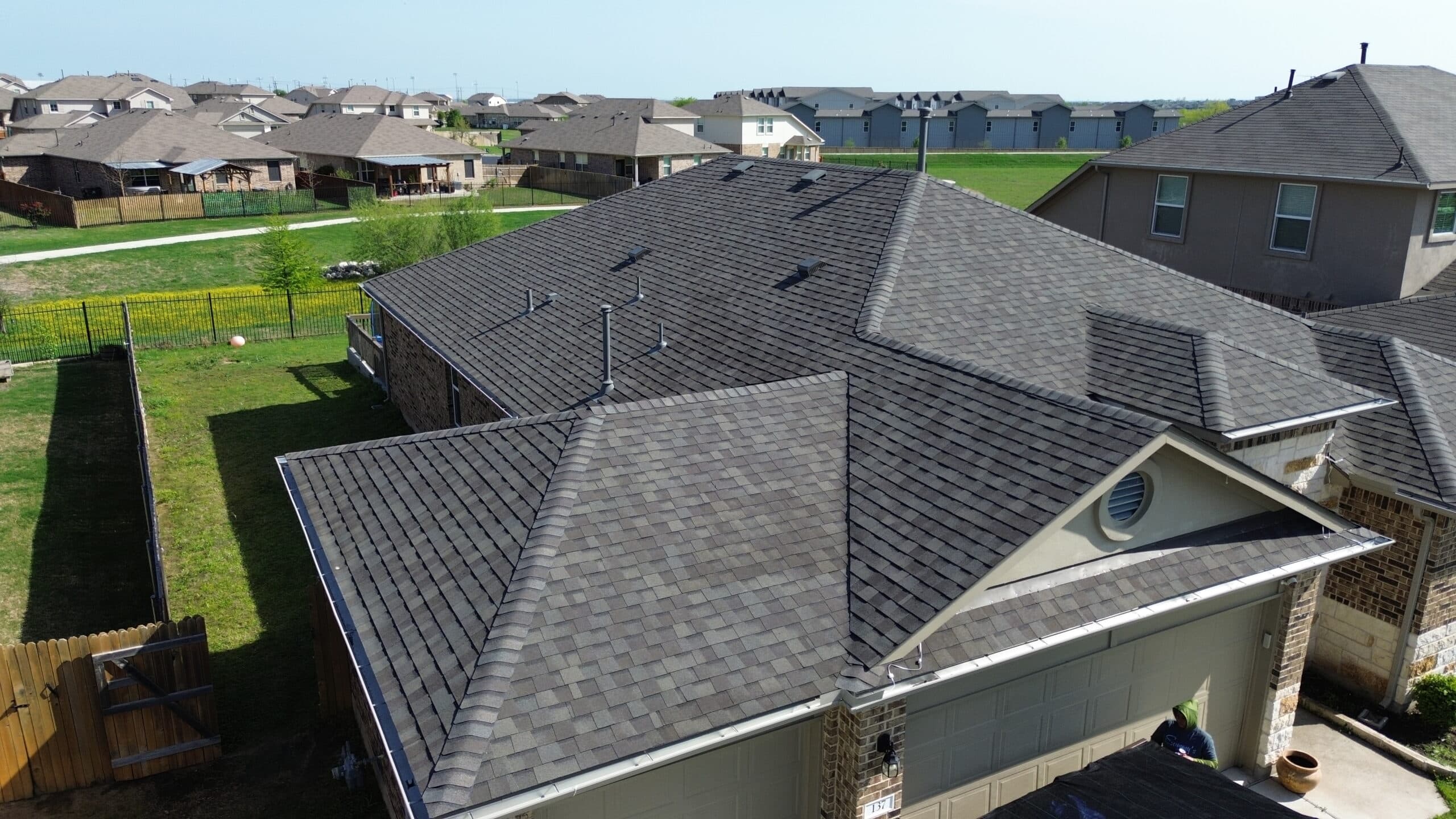
Quick answer: The five roofing problems that show up most often on Georgetown roofs are hail impact damage, heat/UV degradation from Hill Country summers, wind-driven shingle blow-off, damage from poor prior installation, and wildlife/pest intrusion. Each has distinct warning signs and a different fix — this guide walks through how to spot and address each one.
Georgetown's roofs take a beating from a specific combination of factors: a hail-prone stretch of Central Texas, long stretches of 100°F+ summer heat, and a mix of roof ages from 1880s Victorians to brand-new Wolf Ranch construction. Georgetown roofs deal with it all. For a neighborhood-by-neighborhood breakdown (Sun City, Wolf Ranch, Berry Creek, Historic Downtown, and more) plus material recommendations and HOA/historic district process, see our full Georgetown Roofing Guide — this post focuses specifically on diagnosing what's actually wrong with your roof.
As Georgetown's trusted roofing contractor, we see these five problems on Georgetown roofs far more than anything else. Schedule a professional inspection to identify problems before they become expensive disasters.
1. Hail Damage (Georgetown's #1 Roof Destroyer)
Direct answer: Hail is the single most common cause of roof failure in Georgetown. It fractures shingle seal strips, strips protective granules, and cracks brittle materials — often without any visible sign from the ground, which is why post-storm inspections matter even when the roof "looks fine."
The Georgetown Hail Reality:
Williamson County sits in a recurring hail corridor, with the highest risk typically March-May and again September-October. Hail size and storm dates vary year to year — see our Georgetown Roofing Guide for general storm-history context, and always verify the exact date and severity for your address through the National Weather Service storm database rather than assuming based on a neighbor's damage.
Open, tree-sparse neighborhoods (Sun City, Wolf Ranch) and hilltop/elevated lots tend to take the worst of it since there's no tree canopy to absorb impact — our Georgetown Roofing Guide breaks down exposure by neighborhood in detail.
What Hail Does to Georgetown Roofs:
- Shingles: Fractures seal strips, exposes fiberglass mat, creates granule loss (looks like bald spots)
- Metal Roofs: Dents standing seam panels (cosmetic but reduces resale value)
- Clay Tile: Cracks/shatters tiles (common on historic homes)
- Flashing: Bends metal, breaks seals around chimneys and vents
- Gutters: Dents and misalignment causing drainage issues
Warning Signs You Have Hail Damage:
✓ Dark spots or 'bruises' on shingles
✓ Shiny spots where granules are missing
✓ Cracked or torn shingles
✓ Dented gutters, downspouts, or vents
✓ Damaged window screens
✓ Dents on AC units or cars
✓ Broken tree branches or damaged landscaping
Solutions:
Immediate Action:
- Document damage with photos/video (all angles)
- Contact insurance within 48-72 hours
- Get professional roof inspection (free from certified contractors)
- Tarp any areas with active leaks
- Don't let 'storm chasers' pressure you into signing contracts
Long-Term Protection:
- Upgrade to Class 4 impact-resistant shingles (CertainTeed Landmark IR, GAF Timberline HDZ RS)
- Consider metal roofing for Sun City/Westview (50-70 year lifespan, superior hail resistance)
- Install synthetic underlayment (5x stronger than felt)
- Improve attic ventilation (extends shingle life 5-10 years)
- Get insurance discounts (10-35% premium reduction with IR materials)
Georgetown Pro Tip: Historic district homes may require special approval for material changes — HARC reviews roofing projects on designated properties. Class 4 impact shingles that match historic appearance are usually approved. See the Historic District section below for details.
Cost to Fix:
- Partial repair (5-10 squares): $2,500-$5,000
- Full replacement (typical 20-30 square roof): $10,000-$18,000
- Insurance deductible: $1,000-$2,500 typical
- Most hail damage is covered by insurance
2. Extreme Heat & UV Degradation
Direct answer: Sustained summer heat is the slower, quieter counterpart to hail damage — instead of one storm, it's months of thermal cycling that dries out asphalt binders, curls shingle edges, and strips granules years before a roof's rated lifespan is up. It's most severe on roofs with poor attic ventilation.
Georgetown's Heat Challenge:
Georgetown sits on the edge of Texas Hill Country with limited tree canopy in newer developments. Summer temps regularly hit 100-105°F, with roof surface temperatures exceeding 165°F. Sun-exposed, minimally-shaded lots (common in newer developments like Sun City and Wolf Ranch, per our Georgetown Roofing Guide) see the most extreme surface and attic temperatures.
What Heat Does to Roofs:
- Thermal Cracking: Daily expansion/contraction cycles create stress fractures
- Shingle Curling: Edges lift, exposing underlayment to UV rays
- Accelerated Aging: UV radiation breaks down asphalt binders (reduces lifespan by 30%)
- Granule Loss: Protective coating degrades faster in intense heat
- Adhesive Failure: Seal strips lose bond, shingles blow off in wind
- Color Fading: Aesthetic degradation (especially dark colors)
Warning Signs of Heat Damage:
✓ Curled or cupped shingle edges
✓ Cracked, brittle shingles
✓ Excessive granule loss (check gutters)
✓ Faded, discolored appearance
✓ Attic temps above 140°F in summer
✓ High cooling bills (20%+ increase)
Solutions:
Preventive Measures:
- Install cool roof shingles (CertainTeed Solaris, Owens Corning Duration COOL)
- Choose light colors (reflect 30-50% more heat than dark)
- Upgrade attic insulation (R-38 minimum, R-49 ideal)
- Add radiant barrier (reflects 95% of radiant heat)
- Install proper ventilation (1 sq ft per 150 sq ft attic space)
- Use ridge vents + soffit vents (continuous airflow)
Reactive Solutions:
- Replace curled/damaged shingles before they leak
- Apply elastomeric roof coatings (adds 5-10 years lifespan)
- Install solar attic fans (reduces attic temp 20-30°F)
- Consider metal roofing upgrade (reflects 70% solar heat)
What to Expect: Switching from a dark, standard shingle to a light-colored cool-roof shingle with added radiant barrier and balanced ridge/soffit ventilation is one of the highest-ROI upgrades for a sun-exposed Georgetown roof — homeowners typically see a meaningful drop in attic temperature and a noticeable reduction in summer cooling costs, on top of extending shingle life.
Cost to Fix:
- Cool roof shingle upgrade: $800-$1,800 more than standard
- Radiant barrier installation: $600-$1,500
- Ridge vent + soffit vent system: $1,200-$2,800
- Annual energy savings: $250-$700
3. Wind Damage & Severe Thunderstorms
Direct answer: Straight-line thunderstorm winds are Georgetown's second major storm threat after hail, and installation quality determines whether a roof survives them — a properly hand-sealed, 6-nail-pattern roof rarely loses shingles in a storm that strips a corner-cut one.
Georgetown Wind Reality:
Thunderstorms bringing 50-80 mph straight-line winds are common in Central Texas, and Georgetown's location between Temple and Austin puts it in the path of severe weather corridors. See our Georgetown Roofing Guide for general storm-history context — for a specific storm date, verify through the National Weather Service rather than relying on memory.
How Wind Damages Roofs:
- Shingle Blow-Off: Loose or improperly installed shingles rip away
- Lifted Edges: Creates entry points for water infiltration
- Flashing Damage: Metal strips peel back from chimneys, vents, valleys
- Debris Impact: Flying branches, lawn furniture, loose materials
- Underlayment Exposure: Once shingles blow off, rapid water damage occurs
- Gutter Displacement: Heavy winds bend, twist, or detach gutters
Hilltop lots and open, tree-sparse new developments tend to see the highest wind exposure — see our Georgetown Roofing Guide for exposure by neighborhood.
Warning Signs:
✓ Missing or torn shingles
✓ Lifted/curled shingle edges
✓ Exposed underlayment or roof deck
✓ Damaged flashing around penetrations
✓ Granules or shingle debris in gutters
✓ Visible daylight through roof boards
Solutions:
Preventive:
- Hand-seal all shingles during installation (CertainTeed requirement)
- Use 6-nail pattern in high-wind zones (not standard 4-nail)
- Install proper drip edge and starter strips
- Choose wind-rated materials:
- CertainTeed Landmark IR (130 mph wind rating)
- GAF Timberline HDZ (130 mph)
- Metal roofing (140-160 mph)
- Trim tree branches 8-10 feet from roof line
After Storm:
- Inspect roof after every major storm event
- Replace missing shingles within 48 hours (water damage spreads fast)
- Tarp exposed areas immediately
- Document for insurance claims
- Get professional assessment (most are free)
Georgetown Reality Check: Some Georgetown contractors cut corners on installation—4-nail patterns instead of 6, no hand-sealing, improper starter strips. This causes premature wind damage. Look for manufacturer-certified installers (like CertainTeed ShingleMaster Premier) who follow full installation specs rather than the fastest ones.
Cost to Fix:
- Minor wind damage (2-5 shingles): $300-$800
- Moderate damage (5-15 shingles): $800-$2,500
- Major blow-off (20+ shingles): $3,000-$7,000
- Full replacement (severe storm): $12,000-$22,000 (often covered by insurance)
4. Poor Installation by Unqualified Contractors
Direct answer: A large share of the roof failures we're called out to inspect in Georgetown trace back to installation shortcuts, not material failure — missed nailing zones, skipped ice-and-water shield, and reused flashing are the most common culprits, and they typically show up as leaks within the first year or two rather than at the end of a shingle's rated life.
Georgetown's Contractor Problem:
Georgetown's rapid growth has repeatedly ranked it among the fastest-growing cities in the U.S., and that growth has attracted contractors from everywhere—many unlicensed, uninsured, and untrained. Since Texas doesn't license roofing contractors at all, insurance verification and manufacturer certification are the only real screens. After every hail storm, 'storm chasers' flood the area with promises of 'free roofs.'
Common Installation Mistakes We Fix:
- Improper nail placement: Misses shingle nailing zone, causes blow-offs
- Insufficient ventilation: Leads to premature shingle failure (voids warranty)
- Reusing old flashing: Guaranteed leak points at valleys, chimneys
- No drip edge: Causes fascia rot, gutter issues
- Skipping ice & water shield: Required in Texas (yes, even here!)
- Mixed shingle lots: Color mismatch visible from street
- Not removing old layers: Building code violation in most cases
- Improper valley installation: #1 cause of leaks
How to Spot Poor Installation:
✓ Visible nail heads on shingle surface
✓ Wavy, uneven shingle lines
✓ Misaligned shingles at valleys
✓ Exposed underlayment at edges
✓ Inadequate overhang at eaves
✓ Premature granule loss (within 1-2 years)
✓ Daylight visible from attic
Red Flags When Hiring:
❌ Door-to-door sales after storms
❌ Pressure to sign 'today only' deals
❌ Bids 40-50% below competitors
❌ Cash-only transactions
❌ Out-of-state license plates
❌ No local references in Georgetown
❌ Requires full payment upfront
❌ No written contract or warranty
❌ Not certified by manufacturers
❌ Offers to 'waive your deductible' (insurance fraud!)
Solutions:
Before Hiring:
- Verify manufacturer certification (CertainTeed ShingleMaster Premier or equivalent)
- Check Google reviews and ratings, and ask for recent, verifiable references
- Get 3-5 written estimates (itemized, not just lump sum)
- Ask for Georgetown-specific references (call them!)
- Confirm insurance (general liability + workers compensation)
- Review written warranties (labor + materials)
- Visit their physical office (not just PO box)
What Good Installation Looks Like:
✅ CertainTeed or GAF manufacturer certification
✅ Detailed written contract with scope of work
✅ Proper permits pulled (required in Georgetown)
✅ Synthetic underlayment (not cheap felt)
✅ Hand-sealed shingles (wind protection)
✅ Ridge vent + soffit vent system
✅ Ice & water shield in valleys and eaves
✅ All new flashing (never reuse old)
✅ Final inspection and thorough cleanup
✅ Transferable manufacturer warranty (25-50 years, material)
Georgetown Pro Tip: Texas has no state roofing license requirement, but manufacturers require certification for full warranty coverage. Verified insurance and manufacturer certification are your real protection against poor workmanship — not a license number, since none exists to check.
Cost of Poor Installation:
- Tear-off and reinstall: $15,000-$28,000
- Lost warranty value: $5,000-$15,000
- Water damage repair: $3,000-$25,000+
- Legal fees if contractor disappears: $3,000-$10,000
5. Wildlife & Pest Damage
Direct answer: Georgetown's mix of mature-tree neighborhoods and Hill Country ranch land on its edges makes wildlife intrusion a real and often-overlooked roofing problem — squirrels, raccoons, birds, and bats all exploit small gaps in vents, fascia, and soffits, and the entry point often causes more structural damage than the animal itself.
Common Wildlife Problems:
- Squirrels: Chew through roof vents, fascia boards, soffits
- Raccoons: Rip up shingles to access attics
- Birds: Nest in vents, peck at shingles
- Bats: Enter through tiny gaps, cause health hazards
- Woodpeckers: Drill holes in wood trim
- Rats/Mice: Enter through damaged areas, chew wiring
Heavily-wooded, mature-landscaping neighborhoods and lots near water see the most wildlife pressure — see our Georgetown Roofing Guide for neighborhood characteristics.
Warning Signs:
✓ Scratching/scurrying noises in attic
✓ Droppings in gutters or on roof
✓ Chewed or damaged vents
✓ Holes in soffits or fascia
✓ Nesting materials visible
✓ Strong odors from attic
✓ Visible entry points
Solutions:
Prevention:
- Install vent screens (1/4' hardware cloth)
- Use metal flashing on exposed wood
- Trim tree branches 8-10 feet from roof
- Seal all gaps larger than 1/4 inch
- Install chimney caps with screens
- Cover ridge vents with pest-proof screening
Removal:
- Hire wildlife removal specialist ($200-$800)
- Never seal entry points until animals removed
- Repair damage immediately after removal
- Install exclusion devices (one-way doors)
- Consider attic restoration if contaminated
Repair:
- Replace chewed vents: $50-$200 each
- Repair fascia damage: $300-$1,200
- Seal entry points: $400-$1,500
- Attic cleaning/decontamination: $1,500-$4,000
Georgetown Reality: Many Sun City homes have bat problems—attracted to warm attic vents. Professional removal is essential (bats are protected species in Texas). Cost: $500-$2,000 for exclusion.
A Note on Historic District Homes
If your home is inside Georgetown's Downtown or Old Town Historic Districts near the Williamson County courthouse square, roofing problems come with an extra step: the city's Historic and Architectural Review Commission (HARC) has to approve material and color changes via a Certificate of Appropriateness before repair or replacement work starts. This doesn't change what's wrong with the roof — hail, heat, wind, poor installation, and wildlife damage look the same on a Victorian as anywhere else — it just adds an approval step to the fix. For the full HARC/COA process, approved materials, timeline, and cost, see our Georgetown Roofing Guide.
Frequently Asked Questions
Q: What's the most common roofing problem in Georgetown, TX? A: Hail damage. Williamson County sits in a recurring hail corridor, and impact damage — cracked shingles, fractured seal strips, granule loss — is the single most frequent issue we're called out to inspect, often invisible from the ground.
Q: Do I need historic district approval before replacing my roof in Georgetown? A: Only if your home is on a designated property inside the Downtown or Old Town Historic Districts. The Historic and Architectural Review Commission (HARC) reviews material, color, and profile changes on those homes specifically via a Certificate of Appropriateness — most Georgetown homes outside the historic district don't need this approval.
Q: How do I know if my Georgetown roof has hail damage if I can't see it from the ground? A: You often can't tell from the ground — granule loss and impact fractures are usually only visible up close. Check gutters after any storm with golf ball-sized hail or larger; granules washing out is a strong sign, and a free professional inspection is the reliable way to confirm.
Q: Is metal roofing worth the extra cost in Sun City and other exposed Georgetown neighborhoods? A: Often yes, for wide-open, minimally-shaded lots that take the brunt of Hill Country hail and heat. Metal's long lifespan and superior hail resistance can offset the higher upfront cost over the time you own the home.
Q: What's the biggest wildlife problem for Georgetown roofs? A: Bats roosting in attic vents, especially in wooded or lake-adjacent neighborhoods. Bats are a protected species in Texas, so removal has to go through a licensed wildlife specialist rather than DIY sealing, which can trap animals inside.
Get Expert Help for Your Georgetown Roof
Georgetown homeowners trust Ripple Roofing & Construction because we understand local challenges—from historic district requirements to Sun City's unique hail exposure.
Why Choose Us:
✅ CertainTeed ShingleMaster Premier Certified (top 1% of contractors nationally)
✅ SBA Veteran-Owned Certified (verified through the U.S. Small Business Administration)
✅ Historic district experience (we handle HARC/Certificate of Appropriateness applications)
✅ 5.0/5 Star Reviews on Google
✅ Owner-operated, local (not storm chasers)
✅ Lifetime workmanship warranty (transferable to new owners)
✅ Insurance claim experts (we speak their language)
Free Services:
- Comprehensive roof inspection
- Storm damage assessment and documentation
- Insurance claim assistance (meet adjuster, write supplements)
- Historic district application guidance
- Ventilation analysis
- Color matching and visualization
Schedule Your Free Inspection
Call (512) 763-5277 or request a quote online.
Serving all Georgetown areas: Sun City, Wolf Ranch, Berry Creek, Westview, Georgetown Village, Historic District, Cimarron, Teravista, Shell Road, Lakeway Drive, and all surrounding neighborhoods.
Ripple Roofing & Construction serves Georgetown, TX from our Round Rock headquarters. We're CertainTeed ShingleMaster Premier certified and fully insured. Our work is backed by industry-leading warranties and a lifetime workmanship guarantee.