Roof Replacement in Taylor TX: Materials, Process & What to Expect in 2026
A roof replacement is one of the most significant home investments a Taylor, Texas homeowner will make. It's not a purchase you make often — ideally only once in 25 to 50 years, depending on the material you choose. And it's a decision complicated by the fact that you're choosing materials, a contractor, and a process for something you'll never see again once it's installed.
This guide is designed to give you full visibility into every element of a roof replacement in Taylor, TX: when it makes sense to replace instead of repair, which materials work best for Taylor's specific climate and housing types, what happens on installation day, what your contract should actually say, and how to choose a roofing contractor in a market that's increasingly crowded with options following Samsung's massive presence in the area.
We also cover financing, insurance-funded replacements, and what a new roof actually does for your home's resale value — because for many Taylor homeowners, a replacement is both a protection decision and a financial one.
When Does a Roof Replacement Make Sense in Taylor TX?
The hardest part of the replacement decision is knowing when repair tips into replacement. The answer isn't just about age — a well-maintained 22-year-old roof in good condition may be a better repair candidate than a 15-year-old roof with widespread hail damage. Here are the specific indicators that push a Taylor TX homeowner from repair into replacement territory.
Sign 1: Widespread Granule Loss
Asphalt shingles shed granules gradually throughout their lifespan, but there's a difference between normal aging granule loss and the accelerated loss pattern that indicates a roof approaching end of life.
What to look for: Significant granule accumulation in gutters (especially after rain), bare spots visible across the shingle field (not just at localized impact sites), and a "bald" or "shiny" appearance to sections of the field when viewed in raking light. If you can see the underlying asphalt mat in multiple areas across the roof, the shingles have lost their primary UV protection layer and are aging rapidly.
In Taylor's climate — rooftop surface temperatures of 160–180°F in summer, intense UV year-round — a shingle that's lost meaningful granule coverage ages in months rather than years. Repair at this stage is a patch on a failing system.
Sign 2: Multiple Simultaneous Failures
A single failed pipe boot is a repair. Two failed pipe boots, a deteriorated valley, and cracked ridge caps on the same inspection is a pattern. Multiple simultaneous failures across different components of the roof are the clearest sign that the system as a whole is past its useful life.
The analogy: when multiple components in a mechanical system start failing in close succession, it rarely makes economic sense to replace them one by one. The roof is the same. If your inspection inventory includes four or more distinct issues — each legitimate and individually repairable — the total repair cost often approaches replacement cost while still leaving you with an aging system that will continue generating repair calls.
Sign 3: The Roof Is Past Its Rated Lifespan
Standard 3-tab shingles: 15–20 years in Texas conditions. Standard architectural shingles: 20–25 years in Texas conditions (the rated 30 years assumes more moderate climates). Premium architectural and Class 4 shingles: 25–35 years.
If your roof is past these windows — particularly if it has also been through documented hail events — you're in replacement territory regardless of whether a specific active leak has developed. An aging roof that hasn't failed yet is still an aging roof. Proactive replacement before failure is almost always cheaper than reactive replacement after water damage to decking, insulation, framing, and interior finishes.
Sign 4: Decking Compromise Across Multiple Areas
If an inspection reveals soft spots, rot, or moisture damage in the roof decking across more than one area, repair costs escalate quickly. Decking repair is billed separately from roofing (because the contractor can't know how much is compromised until tear-off), and widespread decking issues often indicate that the underlying moisture infiltration has been ongoing from multiple sources — a pattern that targeted repair doesn't fully address.
Sign 5: Structural Issues Revealed on Inspection
In Taylor's older homes especially, a roof inspection sometimes reveals issues beyond the roofing system itself — cracked or settling rafters, ridge board deterioration, inadequate collar ties, or rafter uplift damage from previous wind events. A replacement that includes structural repair is a more comprehensive project than a straight re-roofing, but it's also an opportunity to address issues that would otherwise deteriorate further.
Sign 6: Insurance Replacement After a Major Hail Event
For Taylor homeowners whose roofs have sustained qualifying hail damage, an insurance-funded replacement isn't the same decision as a discretionary one. If your carrier has approved a replacement claim, the decision has effectively been made — the question shifts to which materials to select, which contractor to use, and how to maximize the value of the project. More on this in the insurance section below.
Sign 7: You're Selling the Home
A roof in questionable condition is a negotiating liability in any real estate transaction. Buyers' inspectors will flag roofs with significant wear, and the disclosure requirement creates further complications. In Taylor's current market — active with Samsung-related relocations — buyers have options and are not shy about asking for roof credits or price adjustments. A replacement before listing removes the issue entirely and may return more than its cost in sale price.
Choosing the Right Material for Your Taylor TX Home
Material selection is the most consequential decision in a roof replacement — and in Taylor, the right answer varies significantly depending on your home's age, construction style, and your long-term plans.
Understanding Taylor's Roofing Demands
Any material selected for a Taylor roof needs to contend with:
Extreme heat: Rooftop surface temperatures of 160–180°F in summer. Materials that can't handle sustained thermal stress degrade faster. Ventilation helps, but material quality matters too.
Hail: Taylor's eastern Williamson County location puts it in a regular hail corridor. Impact resistance is a meaningful selection criterion, not just a marketing premium.
UV intensity: Central Texas UV exposure is year-round and intense. UV degrades asphalt at the molecular level; materials with higher UV resistance have meaningfully longer lifespans here.
Wind: Severe thunderstorm winds in Taylor regularly exceed 60 mph. Wind rating matters for shingles — particularly for ridge caps and starter courses.
Material Option 1: Standard Architectural Shingles
What they are: The most common roofing material in Taylor and Central Texas generally. Laminated asphalt shingles with a multi-layer construction that creates a dimensional appearance. Common products include CertainTeed Landmark, GAF Timberline HDZ, and Owens Corning Duration.
How they perform in Taylor: Solid mid-range performance. In Texas conditions, quality architectural shingles realistically deliver 20–25 years — somewhat less than their 30-year ratings, which assume more moderate climates. They handle moderate hail impacts reasonably well but will show damage from golf-ball-sized or larger hail.
Best for: Taylor homeowners seeking a cost-effective, aesthetically neutral replacement with solid performance and a broad contractor network for future repairs.
Cost range (installed, 1,800–2,500 sf home): $12,000–$19,000 depending on pitch, complexity, and material tier within the architectural category.
Limitations: Limited hail resistance compared to Class 4 or metal options. Moderate UV sensitivity. Won't qualify for significant insurance premium discounts without impact-resistant designation.
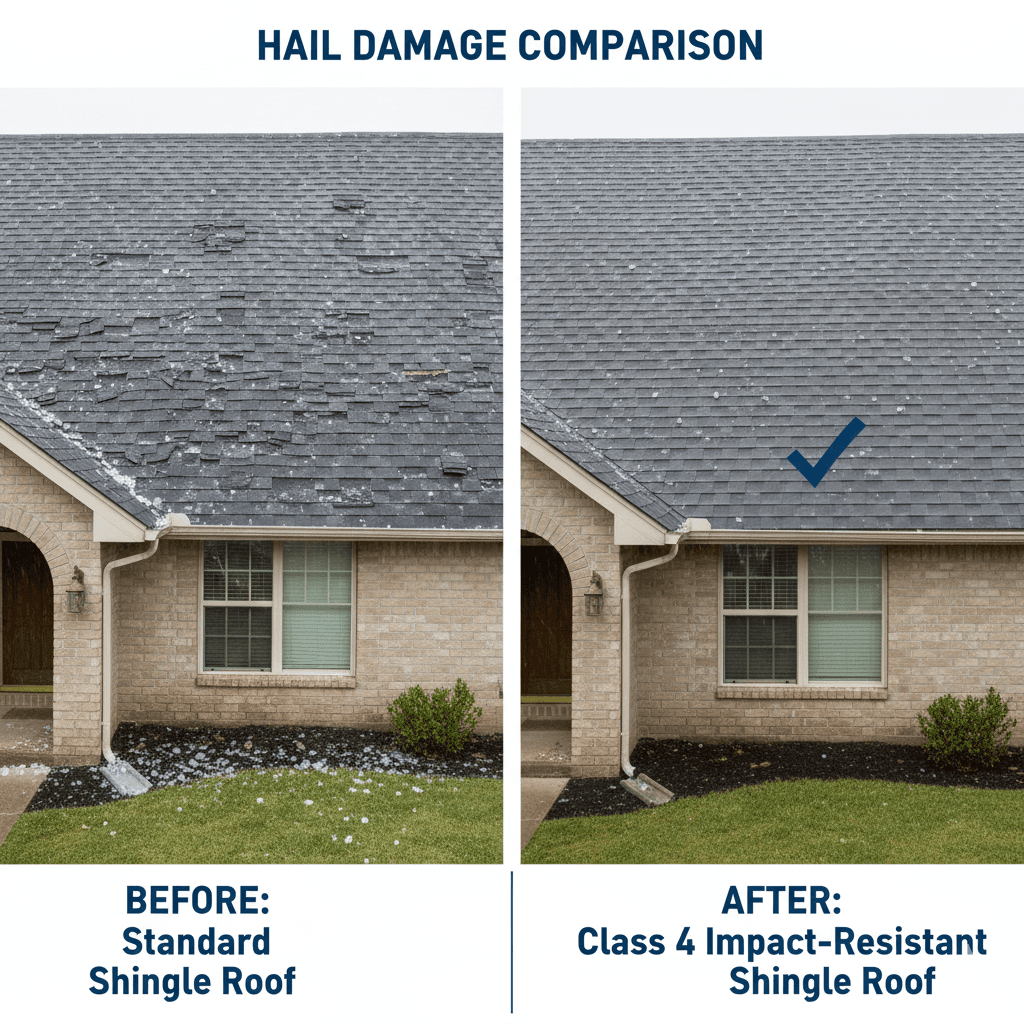
Material Option 2: Class 4 Impact-Resistant Shingles
What they are: Architectural shingles engineered to pass the UL 2218 Class 4 impact test — the highest classification for hail resistance. These shingles use modified polymer blends and reinforced fiberglass mats to absorb impact energy without cracking. Common products include CertainTeed Landmark IR, GAF Timberline UHDZ, and Malarkey Vista AR.
How they perform in Taylor: Significantly better hail resistance than standard architectural — the primary weather threat in Williamson County. Class 4 shingles reduce granule displacement at impact sites and maintain structural integrity through moderate-to-large hail events that crack standard shingles.
Best for: Taylor homeowners who want meaningful protection improvement over standard shingles, particularly those who've had prior hail claims or whose neighborhoods have been in the path of documented events. Also the right call for homeowners planning to stay in the home long-term.
The insurance math: Many Texas carriers — including State Farm, Allstate, USAA, Farmers, and Nationwide — offer 15–30% discounts on the hail/wind component of your homeowners premium for homes with Class 4 roofing. Given Taylor's hail exposure, this discount often recovers the cost premium of Class 4 over standard architectural within 4–7 years.
Cost range (installed, 1,800–2,500 sf home): $14,000–$22,000. The 10–20% premium over standard architectural is the price of meaningfully better performance and, in most cases, ongoing insurance savings.
Limitations: Still an asphalt product — doesn't match the lifespan or total hail immunity of metal options. But represents the best value in the shingle category for Taylor's climate.
Material Option 3: Standing Seam Metal Roofing
What it is: Concealed-fastener metal roofing with vertical seams that interlock and "stand" above the roof plane. Panels run continuously from ridge to eave with no exposed fasteners — the design that eliminates the primary failure point of exposed-fastener metal (fastener holes that eventually leak). Common in premium residential construction and increasingly popular for high-end residential replacements.
How it performs in Taylor: Excellent across all the key criteria. Metal reflects 65–70% of solar radiation (vs. 5–15% for dark asphalt), meaningfully reducing rooftop temperature and cooling load. Hail causes cosmetic denting in light gauges (26 ga) but doesn't compromise the weather barrier. Lifespan of 40–70+ years. Wind resistance of 140+ mph when properly fastened.
Best for Taylor homes: Standing seam is particularly well-matched to Taylor's older historic homes where the visual character of the material complements the architecture. It's also the strongest long-term value proposition for homeowners planning to stay in the home for 20+ years — the last roof they'll ever need to buy.
Aesthetic note: Standing seam comes in a wide range of colors (Kynar finishes) and profiles (1.5", 2", 3" seam heights). On historic downtown Taylor homes, a Charcoal or Slate color in a narrower panel width blends naturally with the architectural character.
Cost range (installed, 1,800–2,500 sf home): $22,000–$38,000. The premium is real and significant. The math changes over a 40-year horizon.
Limitations: Higher upfront cost. Requires experienced installers — this is not a product that should be installed by a crew without documented metal roofing experience. Expansion and contraction in Texas temperatures must be accommodated with proper clip systems.
Material Option 4: Stone-Coated Steel (DECRA, Metro Tile)
What it is: Steel panels coated with stone granules in a cement matrix, producing a product with the visual appearance of traditional tile, shake, or shingles but the structural performance of steel. Brands include DECRA (Shake XD, Tile, Shingle Plus) and Metro Roof Products (Metro Shake, Metro Tile).
How it performs in Taylor: The best hail resistance available in any roofing material — Class 4 rated, but with a steel substrate rather than an asphalt mat. The stone surface absorbs impact energy exceptionally well. Wind ratings exceed 120 mph. Lifespan of 40–70 years. Does not crack, curl, or shed granules.
Best for Taylor homes: For homeowners who have been through multiple hail claims and want to permanently exit that cycle, stone-coated steel is the terminal solution. Once installed, you will not be filing another hail damage claim on this roof — the product simply doesn't sustain the kind of damage that generates claims.
Also excellent for mid-century Taylor homes where the stone-coated appearance (especially in shake or tile profile) complements the architectural character better than standing seam.
Cost range (installed, 1,800–2,500 sf home): $25,000–$42,000 depending on profile and complexity.
Limitations: Highest upfront cost of any option. Requires experienced installers familiar with the specific fastening and flashing requirements of stone-coated steel. Available in specific profiles — not every contractor carries or installs it.
Material Option 5: Concrete or Clay Tile
What it is: Traditional tile roofing materials with excellent longevity (50+ years for clay, 30–50 for concrete) and distinctive aesthetic. Common in Spanish Colonial, Mediterranean, and Texas Hill Country-style homes.
Relevance to Taylor: Limited. Taylor's housing stock is predominantly asphalt shingle construction. Tile is a consideration primarily for homeowners with existing tile roofs (replacement in-kind) or for new additions to homes with existing tile. The structural requirements of tile roofing (heavier load) mean it can't be simply substituted for shingles without a structural evaluation.
Material Comparison Summary
| Material | Lifespan (TX) | Hail Rating | Cool Roof | Installed Cost (1,800–2,500 sf) |
|---|---|---|---|---|
| Architectural Shingles | 20–25 yr | Moderate | No | $12,000–$19,000 |
| Class 4 Impact-Resistant | 25–30 yr | Class 4 | Partial | $14,000–$22,000 |
| Standing Seam Metal | 40–70 yr | Excellent | Yes | $22,000–$38,000 |
| Stone-Coated Steel | 40–70 yr | Class 4+ | Partial | $25,000–$42,000 |
Matching Material to Taylor Home Type
Historic Homes (Pre-1970): Downtown Taylor and Established Neighborhoods
Best material choices: Standing seam metal or premium architectural shingles.
Standing seam metal complements the character of older Taylor homes — particularly the craftsman bungalows and farmhouse styles near the historic downtown square. A Charcoal or Slate standing seam profile on a 1940s bungalow looks intentional and appropriate, adds significant durability, and eliminates the future re-roofing conversation entirely.
For homeowners who want to stay within traditional shingle territory, CertainTeed's Landmark premium line or equivalent offers architectural shingles with thicker construction, better UV resistance, and longer warranty coverage than standard architectural.
Special considerations: Pre-1970 homes often have board sheathing decking. A replacement on board sheathing requires crews experienced with the installation — proper nailing patterns, identification of compromised boards, and in some cases installation of a thin plywood overlay for a consistent nailing surface. Not all Taylor roofing companies have this expertise — ask specifically.
Mid-Century Homes (1970–2000): Established Residential Taylor
Best material choices: Class 4 impact-resistant shingles, or stone-coated steel for homeowners who want maximum longevity and hail immunity.
Mid-century Taylor homes have been through enough Central Texas hail seasons that the upgrade to Class 4 is clearly justified. The insurance premium savings typically recover the Class 4 premium within 4–6 years, and the protection improvement is substantial.
For homeowners in mid-century Taylor homes who've had 2+ hail claims and are ready to be done with the cycle, stone-coated steel — particularly in DECRA's Shake or Shingle Plus profile — provides an excellent aesthetic match to this construction era while permanently solving the hail problem.
Special considerations: This age range commonly has attic ventilation at suboptimal levels. A replacement is the right time to upgrade ventilation — ridge vents combined with proper soffit ventilation can reduce attic temperatures by 20–30°F, extending the new roof's lifespan meaningfully.
New Construction Era (Post-2000): Taylor Ranch, Mustang Creek, and Samsung-Area Subdivisions
Best material choices: Class 4 impact-resistant shingles as the standard recommendation; stone-coated steel for long-term-oriented homeowners.
New-construction Taylor homes typically have simpler rooflines and standard OSB decking in good condition — the most straightforward replacement candidates in the market. The material decision here is primarily about the hail/longevity tradeoff, not construction complexity.
Given that many of Taylor's post-2000 homeowners are in the 30–50 age range (prime Samsung workforce demographic), a stone-coated steel installation at replacement time makes compelling long-term sense: you're potentially covering your home for the remainder of the time you'll live there, eliminating future re-roofing decisions.
The Roof Replacement Process in Taylor TX: Step by Step
Understanding the full replacement process eliminates surprises and helps you evaluate whether a contractor is following best practices.
Phase 1: Inspection and Scope
A legitimate replacement starts with a comprehensive inspection — not a quick glance from the ground. A thorough pre-replacement inspection includes:
- Walking every section of the roof to assess shingle condition, granule coverage, and any visible damage
- Inspecting all flashings at every penetration, wall transition, and chimney
- Checking valley conditions
- Assessing pipe boot status
- Inspecting drip edge and fascia
- Attic check for ventilation, moisture, and structural issues
The inspection findings drive the scope document — the written specification of exactly what's being done, what materials are being used, and what's included or excluded. You should receive and review this document before signing any contract.
Phase 2: Material Selection and Contract Execution
After reviewing the scope, you select your material (shingle product, color, and tier), confirm the scope of work, and execute the contract. A well-structured roofing contract (more on this below) specifies everything in writing — materials by manufacturer name and product line, labor scope, warranty terms, payment schedule, and timeline.
Lead times: Material ordering is typically done by the contractor at or shortly after contract execution. In Taylor's current market — with construction demand elevated by Samsung-related activity — lead times for premium materials (Class 4 shingles, metal panels, stone-coated steel) can run 1–3 weeks beyond standard. Your contractor should give you a realistic timeline at contract signing.
Phase 3: Preparation and Protection
On installation day (or the day before for larger projects), the crew prepares the site:
- Tarps are laid around the perimeter to catch falling debris
- Landscaping and A/C units are protected
- Satellite dishes and solar panels (if present) are noted and protected
- Dumpster or trailer is positioned for debris
Phase 4: Tear-Off
The existing roofing material is removed completely — down to the decking. On a properly managed tear-off:
- Shingles, underlayment, and in some cases old metal flashing are removed
- The crew works in sections to minimize the period any portion of your decking is exposed to the sky
- Debris is cleared continuously to the dumpster or trailer — not allowed to accumulate and slide off the eaves into landscaping
What gets inspected at tear-off: Once the decking is exposed, the crew inspects every sheet for rot, soft spots, or moisture damage. Any damaged decking is marked, and the homeowner is notified before replacement — this is the appropriate time to confirm scope and cost for any decking repairs discovered. Reputable contractors do not proceed with decking repair without your knowledge and authorization.
On board-sheathed homes (common in older Taylor construction), individual boards are inspected rather than sheets — same process, different unit of inspection.
Phase 5: Deck Preparation
After tear-off and decking assessment:
- Any necessary decking repairs are completed
- Drip edge is installed along all eaves (before underlayment) and rakes (after underlayment)
- Ice and water shield is installed at all valleys, eaves, and around penetrations — in Taylor's climate, this is a quality-of-installation indicator as much as a code requirement
- Synthetic underlayment (or felt on lower-spec projects) is installed across the field
What distinguishes quality deck preparation: The details that the homeowner never sees — drip edge that extends properly beyond the fascia, ice and water shield at every valley and penetration (not just selected ones), and underlayment that's properly overlapped and fastened. A contractor who cuts corners here saves 30–60 minutes on the install and costs you years of service life.
Phase 6: Shingle (or Panel) Installation
For asphalt shingles:
- Starter course along all eaves
- Field shingles installed in courses from eave to ridge, with proper offset patterns
- Hip caps and ridge caps installed at all hips and ridges
- Hand-sealing at all penetrations (pipe boots, HVAC curbs, skylights)
- Ridge vents installed (if included in scope)
For standing seam metal:
- Panel clips installed on the decking (concealed fastener system)
- Panels snapped into clips and seamed — no exposed fasteners in the field
- Trim and flashing at all edges, penetrations, and transitions
- Thermal movement accommodation throughout (metal expands and contracts significantly in Texas temperatures — a properly installed system accounts for this; an improperly installed one develops noise and potential leak issues)
For stone-coated steel:
- Battens and counter-battens installed over the decking (creates the drainage plane)
- Panels fastened through the batten system
- Trim and flashing at all edges and penetrations
- Closure strips at ridge and eave
Phase 7: Final Inspection and Cleanup
After installation:
- A thorough visual inspection of the full roof surface
- Final check of all penetration flashings and sealants
- Gutter cleaning (debris accumulates during install — clearing before you leave is standard)
- Magnet sweep of the yard for nails
- Removal of all tarps, dumpster/trailer, and site materials
What you should receive at completion:
- Written notice of completion with contractor signature
- Manufacturer warranty registration documentation
- Workmanship warranty in writing
- Permit final (if permit was pulled)
- Before-and-after photos from the contractor
Phase 8: Manufacturer Warranty Registration
For CertainTeed, GAF, Owens Corning, and most other major shingle manufacturers, the warranty must be registered within a specific window (usually 30 days) of installation completion. Certified contractors (CertainTeed ShingleMaster Premier, GAF Master Elite, etc.) typically handle this registration on your behalf — confirm that this step will be completed.
Timeline Expectations for Roof Replacement in Taylor TX
How Long Does a Roof Replacement Take?
The installation itself — assuming normal complexity and a full crew — typically takes 1–2 days for a standard residential roof in the 1,500–2,500 sf range. Larger homes (3,000+ sf), complex rooflines, steep pitches, or premium materials (metal, stone-coated steel) add time.
Day 1: Tear-off, decking inspection and repair, deck preparation, underlayment, and typically most or all of field installation. Day 2 (if needed): Completion of field, all caps and trim, penetration flashing, cleanup and inspection.
Contractor Scheduling Availability in Taylor
This is a Taylor-specific consideration. The Samsung semiconductor campus and associated residential development have driven significant construction demand in the Taylor and Williamson County market. The best roofing contractors — those with CertainTeed or GAF certifications, strong local reviews, and established crews — are in high demand.
Practical implications:
- After a major storm event, the backlog for established contractors can run 4–8 weeks
- Pre-storm-season replacements (late winter / early spring, before April hail season) often schedule faster than post-storm requests
- If you're planning a proactive replacement (not emergency-driven), scheduling 3–6 weeks in advance gives you access to the full field of contractors
Best Time of Year to Replace a Roof in Taylor TX
Ideal window: October through March (post-hurricane season, pre-hail season). Temperatures are moderate, storm risk is lower, and contractor availability is typically better than the spring/summer peak.
Avoid if possible: Peak hail season (March–June), which creates surge demand and longer waits. High summer (July–August), when extreme heat creates longer daily installation windows and some material handling challenges for asphalt.
Emergency replacements: Happen whenever they need to happen. A well-run roofing company has processes for managing weather-contingent scheduling and will be transparent about what conditions allow safe installation.
Your Roofing Contract: What It Should Say
A Taylor TX roof replacement contract should be specific enough that you could hand it to a different contractor and they'd know exactly what to do. Here's what should be present:
Required Elements
Project scope: Not just "replace roof" but the specific activities — full tear-off vs. overlay (overlay is generally not recommended), number of layers to remove, decking repair protocol, and all installation components.
Material specifications: By manufacturer name, product line, and specific product. "Architectural shingles" is not a specification. "CertainTeed Landmark Pro in Mochaccino" is a specification. Same principle applies to underlayment type, drip edge gauge, and ice-and-water shield brand.
Warranty terms: Both the manufacturer warranty (and at what tier — a CertainTeed ShingleMaster Premier contractor can offer a Lifetime SureStart PLUS warranty that a non-certified contractor cannot) and the contractor's workmanship warranty duration and what it covers.
Payment schedule: A legitimate contractor does not require full payment upfront. A reasonable structure is a deposit at contract signing (10–25%), payment at material delivery or installation start, and balance at completion. If a contractor asks for 50%+ upfront on a large project, that's a flag.
Timeline: Start date, projected completion, and what triggers schedule adjustments (weather, material availability).
Permit: Confirmation of who pulls the permit and that the permit cost is included (or explicitly separated and specified).
Cleanup: Explicit inclusion of debris removal, magnet sweep, and gutter clearing.
What's Often Left Out (But Shouldn't Be)
Decking repair pricing: If the contractor knows (before tear-off) that decking repair is a possibility, the contract should specify the rate — per sheet of OSB, or per linear foot of board repair — so there's no surprise when it's discovered.
Old flashing disposition: Specify whether existing metal flashing at walls and chimneys will be reused or replaced. New material is almost always better, but "we'll reuse what's in good shape" without definition creates ambiguity.
Pipe boots: Whether existing pipe boots are being replaced or inspected and reused. On any roof over 12 years old, replacement at the time of re-roofing is the correct answer — the marginal cost is minimal, and you won't need to open the new roof for boots for 20+ years.
Financing Options for Taylor TX Homeowners
A roof replacement is a significant expense, and not every homeowner has the full cost sitting in a savings account. Several financing options are commonly available:
Contractor Financing
Many roofing contractors partner with financing companies (GreenSky, Hearth, Service Finance Company) to offer project-specific financing. Terms typically include:
- 12-month no-interest promotions (if paid in full within the promotional period)
- Fixed-rate installment options at current market rates (typically 7–12%)
- Approval based on credit score and project amount
Contractor financing is convenient — apply and get a decision at the time of contract signing — but compare rates to alternatives before committing.
Home Equity Options
Home Equity Line of Credit (HELOC): A revolving credit line against your home equity. Current HELOC rates in Texas are in the 7–9% range (2026 market). A HELOC gives flexibility but requires application, approval, and typically 2–4 weeks to fund.
Home Equity Loan: Fixed-rate installment loan against home equity. More predictable payment structure than a HELOC. Same timing considerations.
For Taylor homeowners who've owned for several years, home equity may be the most cost-effective financing option — particularly if current HELOC rates are below contractor financing rates.
Manufacturer Financing Programs
CertainTeed, GAF, and other manufacturers occasionally offer promotional financing through their certified contractor networks. Ripple Roofing, as a CertainTeed ShingleMaster Premier certified contractor, has access to current CertainTeed financing programs — ask us for current availability.
Property Assessed Clean Energy (PACE)
For Taylor homeowners selecting a metal or cool-roof material with energy efficiency benefits, PACE financing (repaid through property tax assessments) may be available. PACE is more commonly used for solar and HVAC upgrades but is increasingly available for qualifying roofing materials.
Insurance-Funded Roof Replacement in Taylor TX
A meaningful share of Taylor roof replacements each year are insurance-funded following hail or wind events. The process is distinct from a discretionary replacement in several important ways.
How an Insurance Claim Replacement Works
Step 1: Contractor inspection first. Before you contact your carrier, have an independent contractor inspection with a written scope. This gives you your own documentation of the damage — which matters when the adjuster's assessment differs from reality.
Step 2: File the claim. Contact your carrier with your claim number. Texas gives homeowners one year from the date of the storm to file a claim — but earlier is generally better, as contractor availability is better before the post-storm surge.
Step 3: Adjuster walkthrough. Your carrier sends a field adjuster to inspect. Having your contractor present at this walkthrough significantly improves outcomes — two professionals on the roof reviewing the same evidence produces more complete documentation than an adjuster reviewing alone.
Step 4: Settlement and scope. Your carrier issues an Actual Cash Value (ACV) check — the replacement cost minus depreciation. For a 15-year-old roof, the depreciation deduction can be substantial.
Step 5: Replacement completion. Your contractor completes the replacement.
Step 6: Supplemental claim. You submit the final invoice to your carrier, and they release the depreciation holdback (recoverable depreciation) — bringing your total settlement up to Replacement Cost Value (RCV).
Your out-of-pocket cost on an insurance-funded replacement is typically your deductible — commonly $1,000–$2,500, or 1–2% of home value on wind/hail-specific policies.
Important: Never accept a contractor offer to "cover your deductible" or waive it through inflated invoicing. This is insurance fraud in Texas. A contractor who makes this offer is a contractor to avoid entirely.
Supplement Claims in Taylor
Taylor homeowners occasionally find that their initial carrier settlement is lower than the actual scope of replacement — particularly on older homes with board sheathing that requires additional labor, or on homes where the carrier's initial scope missed secondary damage (flashing, boots, gutters).
Working with a contractor who has experience in insurance supplement negotiations can recover significant additional value. Ripple Roofing regularly supplements initial carrier settlements to ensure our Taylor customers receive the full scope their policy entitles them to.
For a full walkthrough of the Taylor hail damage and insurance claim process, see our Taylor TX hail damage guide.
What a Roof Replacement Does for Your Home's Value
Resale Value
A new roof is one of the few home improvements that consistently recovers most of its cost at resale in Texas. Remodeling Magazine's Cost vs. Value report consistently shows roofing recovering 60–70% of project cost in resale value in Texas markets. In practice, in a market like Taylor where buyers are often moving from other states (Samsung workforce relocations) and unfamiliar with local roofing norms, a new roof can be a stronger differentiator than those averages suggest.
More importantly, a roof in poor or uncertain condition is a direct negotiating liability. A buyer's inspection that flags the roof leads to repair requests, price concessions, or deal-threatening complications. A new roof eliminates this variable entirely.
Energy Savings
Standard asphalt shingles absorb 85–95% of solar radiation. Metal roofing with cool-roof coatings reflects 65–70%. Stone-coated steel reflects roughly 30–40%. For Taylor homeowners, where cooling costs are the dominant energy expense, the difference between absorptive and reflective roofing can meaningfully affect summer electricity bills.
If you're choosing between standard and Class 4 shingles, the energy efficiency difference is modest. If you're choosing between asphalt and metal, the difference is meaningful — metal installations often see 15–25% reductions in summer cooling costs.
Insurance Premium Impact
As noted in the material section, Class 4 impact-resistant shingles qualify for 15–30% discounts on hail/wind premium components with most Texas carriers. Metal and stone-coated steel may qualify for additional fire-resistance discounts depending on your carrier.
Request updated premium quotes from your insurance carrier after replacement — specifically asking about Class 4 and impact-resistant discounts if you've selected qualifying materials. These savings compound annually for the life of the roof.
How to Choose a Roofing Contractor for Roof Replacement in Taylor TX
The contractor decision matters as much as the material decision. The best materials installed by an inexperienced crew produce mediocre results. Here's how to evaluate contractors in Taylor's current market.
Non-Negotiable Credentials
Insurance: Texas does not currently require roofing contractors to hold a state license, so a Certificate of Insurance is your real screening tool. Verify it directly with the carrier. Any contractor who can't provide one should be disqualified.
Certificate of Insurance: Require a current Certificate of Insurance showing general liability coverage at $1 million minimum and workers' compensation. Ask to be listed as an additional insured on the GL policy for the duration of the project. If a worker is injured on your property and the contractor has no workers' comp, you may be liable.
Manufacturer Certification: The contractor's certification tier with major manufacturers determines what warranty they can extend to you. CertainTeed's certification tiers:
- ShingleMaster: entry-level certification
- ShingleMaster SELECT: mid tier
- ShingleMaster Premier: highest tier — required to offer Lifetime SureStart PLUS warranty
GAF's tiers:
- Certified Contractor
- Master Elite (top tier — fewer than 2% of contractors nationwide)
A non-certified contractor can still install quality shingles, but they cannot pass through the full manufacturer warranty. For a project of this size, working with a certified contractor is worth the preference.
Physical Texas Address: A P.O. box is not a business address. Storm chaser operations and out-of-state contractors often operate without a verifiable physical location. A local Taylor or Williamson County address (or an established Round Rock/Austin address for companies serving the region) indicates an ongoing, stable business.
Questions to Ask During the Bid Process
- Can you provide a Certificate of Insurance right now? (Any established contractor should have this immediately available — Texas has no roofing license to check instead.)
- What's your CertainTeed or GAF certification tier? What warranty tier does that allow you to offer?
- Who are your installers — employees or subcontracted labor? (Employees are generally preferable; if subcontracted, ask whether the sub is insured.)
- What's your process when unexpected decking damage is found at tear-off? (The right answer: notify you immediately, get written authorization before proceeding.)
- Can you provide references from Taylor, TX or Williamson County specifically from the last 12 months?
- What's your timeline for this project, and what would push it?
Red Flags to Avoid
- "We'll waive your deductible" — insurance fraud in Texas, full stop
- Demand for more than 25–30% deposit on a project you haven't started
- No written contract before work begins
- Pressure to sign same-day without time to read and review
- No permit pulled on a project that requires one
- Inability to provide a Certificate of Insurance on request
- Door-to-door solicitation immediately following a storm without any prior relationship — the classic storm chaser pattern
Frequently Asked Questions: Roof Replacement in Taylor TX
How long does a roof replacement take?
For a typical Taylor residential roof (1,500–2,500 sf, standard pitch, asphalt shingles), installation takes 1–2 days. Metal and stone-coated steel projects typically run 2–4 days due to the different installation systems. Larger or more complex homes take proportionally longer.
Do I need to be home during the replacement?
Not necessarily during installation, but you should be available by phone for any questions that arise — particularly regarding unexpected decking damage or scope adjustments. Be home for the pre-installation walkthrough and the completion inspection.
Will my neighbors be affected?
Roofing is noise-generating but typically confined to your property. The crew arrives early (typically 7–7:30 AM) and works through the day. If you're in a close-knit neighborhood, a heads-up to immediate neighbors is courteous.
Can I stay in my home during the replacement?
Yes. Most homeowners stay home during roofing. The noise is significant but not prohibitive. If you have infants, work from home, or have specific noise sensitivities, discuss timing with your contractor.
What happens if it rains during my replacement?
Reputable contractors monitor weather closely and schedule starts around weather. If rain is unexpected, the crew will protect any exposed decking with tarps and resume when conditions allow. A partial tear-off is never left unprotected overnight.
Should I get multiple bids?
Yes — get 3 bids. Compare not just price but scope, material specifications, warranty terms, and credentials. A bid that's 20% lower may be excluding components the others include, or using lower-tier materials. An itemized scope makes comparison meaningful.
How do I know the replacement is done correctly?
Request before-and-after photos from the contractor. Ask to see photos of the drip edge installation, the ice-and-water shield at valleys, and the fastening pattern on the shingles. A contractor who photographs these components demonstrates they're doing them right. You can also walk the perimeter after completion to inspect drip edge, flashing, and ridge cap quality yourself.
What warranty will I get?
Expect two warranties: the manufacturer warranty on the materials (20–30 years for standard architectural, lifetime for CertainTeed Landmark products installed by ShingleMaster Premier contractors), and the contractor's workmanship warranty (typically 5–10 years for quality contractors, sometimes longer). Get both in writing.
Does my homeowners insurance cover a replacement?
Damage from a covered peril (hail, wind, lightning, fire) is typically covered by homeowners insurance, subject to your deductible. Normal aging and wear is not covered. See our Taylor TX hail damage and insurance claim guide for a complete walkthrough of the claims process.
Schedule a Free Roof Replacement Estimate in Taylor TX
Ripple Roofing is a CertainTeed ShingleMaster Premier-certified roofing contractor serving Taylor, Texas and all of Williamson County. Premier certification — the highest CertainTeed tier — means we can offer Lifetime SureStart PLUS warranties that non-certified contractors cannot.
We provide free, no-obligation roof replacement estimates with a written scope, material specifications, and warranty terms clearly stated — everything you need to compare bids and make an informed decision.
We serve all Taylor neighborhoods: Historic Downtown Taylor, Taylor Ranch, Mustang Creek, Heritage Oaks, Donahoe Creek Estates, North Taylor, East Taylor, and the Murphy Street District. We're based in Round Rock, 15 minutes from Taylor, with current availability for both scheduled replacements and storm-damage inspections.
Schedule your free roof replacement estimate in Taylor TX or call (512) 763-5277. We're available 24/7 for storm emergencies and can typically schedule routine replacement consultations within 3–5 business days.